Who supports the mental health of leaders in your workplace?
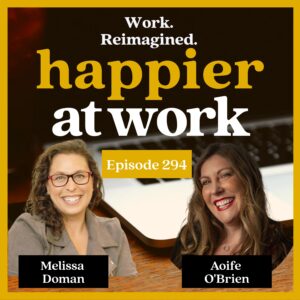
In the latest episode of the Happier at Work podcast, Aoife O’Brien welcomes back organisational psychologist and leadership mental health expert Melissa Doman. This honest and eye-opening conversation explores why it’s crucial to support not just employees, but leaders as well. Melissa reveals how leaders are often expected to have it all figured out and endlessly support others, while their own mental health needs are overlooked. Drawing on research and her forthcoming book “Cornered Office,” Melissa explains the hidden pressures leaders face, the human cost of dehumanising leadership roles, and tangible strategies to help leaders show up authentically at work.
In This Episode, You’ll Discover:
- The myth that leaders naturally have better mental health and don’t need support is untrue and harmful.
- How workplace systems and society often perpetuate the idea that leaders should be strong, have all the answers, and not show weakness.
- The SCARF model (Status, Certainty, Autonomy, Relatedness, Fairness), and how it helps leaders and employees identify workplace triggers and address unmet needs.
- Practical coping methods for leaders, including emotional awareness, open communication, appropriate boundary-setting, and knowing when to seek external support.
Related Topics Covered:
Power Dynamics at Work, Stereotypes, Boundaries at Work
Connect with Aoife O’Brien | Host of Happier at Work®:
Connect with Melissa Doman | Organisational psychologist and leadership mental health expert:
Related Episodes You’ll Love:
Episode 242: Transforming Mental Health Conversations at Work with Melissa Doman
About Happier at Work®
Happier at Work® is the podcast for business leaders who want to create meaningful, human-centric workplaces. Hosted by Aoife O’Brien, the show explores leadership, career clarity, imposter syndrome, workplace culture, and employee engagement — helping you and your team thrive.
If you enjoy podcasts like WorkLife with Adam Grant, The Happiness Lab, or Squiggly Careers, you’ll love Happier at Work®.
Join Aoife O’Brien for weekly insights on leadership, workplace culture, career clarity, imposter syndrome, and creating work that works for you.
Editing by Amanda Fitzgerald.
Website: https://happieratwork.ie LinkedIn: https://www.linkedin.com/in/aoifemobrien/ YouTube: https://www.youtube.com/@HappierAtWorkHQ
Mentioned in this episode:
Thriving Talent book
Aoife O’Brien [00:00:01]:
As leaders, we’re often asked to support the mental health of other people. But who are the ones who are supporting mental health in leaders themselves? In today’s episode, Melissa Doman joins me for the second time, this time talking specifically about mental health from a leadership perspective and how to support leaders at work. We do a pretty deep dive into the kinds of things, the kind of ways that leaders can act out, the ways that they can get triggered. We talked about discomfort versus feeling, feeling uncomfortable and how to tolerate that for a little bit longer. We do a deep dive into the specific ways that this can show up for leaders and some practical strategies that you can implement straight away. I really hope you enjoyed today’s episode. Do get involved with the conversation over on LinkedIn and I’d love to hear from you. Reach out to me on podcastappieratwork, ie.
Aoife O’Brien [00:00:51]:
Melissa, welcome back to the Happier at Work podcast. We talked last year all about mental health at work and this time we’re going to talk specifically about leaders and what that. So maybe for anyone who hasn’t met you before, talk to us about your journey, but also what’s changed since we last met.
Melissa Doman [00:01:10]:
I am so happy to be back on the show. Thank you so much. And gosh, a lot’s happened in the last few years. So I am an organizational psychologist, former mental health therapist, and I specialize in mental health at work. So I teach companies, leaders and individuals how to have skills based on constructive conversations about mental health communication and team dynamics in the workplace. So my clients range from really large organizations like Google, Salesforce, Estee Lauder, to mid size organizations like Orlando City Soccer Club to small companies and everything in between across industries and around the world. And the reason that I left clinical work a number of years ago is I felt like I was treating clients in a broken system and a broken narrative. And I thought this is not gonna, you know, know, make a difference.
Melissa Doman [00:02:01]:
I feel like I need to make an impact at one of the sources especially, which was, is the workplace. Yeah, because most, if not all of my clients would tell me how they didn’t feel safe to talk about their mental health at work and also how their companies were a source of. Source of stress. So I switched into industrial organizational psychology a number of years ago and that was definitely the right place to go. And it’s been really an incredible journey, you know, selfishly creating workplaces that, you know, my generation certainly didn’t have access to growing up in the world of work. And there is no shortage of work to be done teaching people how to talk to each other about the human experience and how to share their toys a bit better at work too.
Aoife O’Brien [00:02:53]:
Yeah. Is that what it’s about? It’s about, you know, and I suppose I’d love to understand a bit more about the evolution in the workplace and how we’re starting to talk about this a bit more, but is that really about what it is? It’s about being human and showing up as ourselves and. And having maybe a better understanding of ourselves.
Melissa Doman [00:03:09]:
Yeah. And I, I wrote a lot about this in my upcoming book where I made this joke saying allow my teeny tiny nihilist to come out for a minute where I was saying, you know, we have created, created from nothing industries, services, goods, titles, the concept of work. These are all human created ideas and structures. It does not change the organisms, the humans that are participating in all of that. And historically speaking, the work self and the personal self has had this partition between it. But the last time I’ve checked, it’s one brain and one body that does all of it. And so the things that I have been encouraging have been really stripping away the agreed upon sociological biases and nomenclature and norms surrounding work and, you know, behaviors in the workplace that we’ve all somewhat agreed upon. And it has been an evolution.
Melissa Doman [00:04:14]:
But I think where we are now was honestly born of desperation because people just couldn’t keep acting as if these selves were separate anymore, even though many people still do and are given every reason to. I think that many workplaces have realized that talking about mental health in the workplace is a necessity, not because they want to, but you know what, if change is born of necessity, then it’s more likely to be done systematically and sustainably as opposed to. As a. Nice to have.
Aoife O’Brien [00:04:49]:
Yeah. And I know, Melissa, I want to touch on your new book that it’s specifically about leaders. So what, where did that come from?
Melissa Doman [00:04:59]:
So a lot’s changed since you and I last spoke and thanks to my adhd, the real kind, not the TikTok kind. You asked me that question a couple minutes ago and now I’m coming back around to answer it. So, you know, I found, and I was quite honest about this in the book. So it’s called Cornered Office. Love a good pun. Cornered Office. Why we need to talk about Leadership Mental health. And I wrote either in the preface or the intro, that when I started specializing in mental health at work, that I was part of the problem.
Melissa Doman [00:05:31]:
Some of the things that I was doing, much like many other people back then, still dehumanized leaders, expecting them Only to support the mental health of their teams and that they would not need that support themselves and that they would just be open to doing it. And it’s just part of the gig.
Aoife O’Brien [00:05:51]:
Yeah.
Melissa Doman [00:05:51]:
And I was part of the problem. And so I saw them as these impact points, which they absolutely are in the workplace. But I was making these assumptions like anybody else that they didn’t need that same care turned towards them because of how they had progress and ascended in their careers. And I wrote about, in the book, I could pinpoint the day when I was doing a workshop for a group of leaders and one of them was like, this is all well and good, but you haven’t even asked us how we feel about doing this. If we need support, you know, what about that? And I was like, oh my God. I was mortified. And so over the years when I did a lot of leadership coaching with leaders of all levels of seniority and, and workshops and just working with them, and I really just started seeing them as the human being sitting in front of me, not what they were responsible for. Like society had also conditioned me to do.
Aoife O’Brien [00:06:57]:
Yeah.
Melissa Doman [00:06:57]:
And in recent years I was digging deeper and deeper and then finally I was just like, is there a reason no one is just talking about if we want them to do better, how we need to support them better and to stop dehumanizing that in order to do that. And then I went down a rabbit hole and I found an absurd amount of research that’s all included in the book where I was like, okay, we need to start stripping away all of these arbitrary rules and agreements that don’t give leaders any form of psychological contracts for themselves to have honored and just expecting them to facilitate that for others because I just don’t see how this is sustainable.
Aoife O’Brien [00:07:40]:
Yeah.
Melissa Doman [00:07:40]:
And then the, the idea for the book started to form and the rest was history.
Aoife O’Brien [00:07:46]:
So.
Melissa Doman [00:07:47]:
76, 000 words later, here we are.
Aoife O’Brien [00:07:50]:
Yeah, I can relate. Just at the final stages, the final, final edits. I hope so. From what you’re saying, I think interventions we, we typically think of it starts from the bottom and we need to sort it out from the bottom. And the leaders are the ones to implement it, they’re not the ones that need it. While also at the same time thinking, well, leaders, they have all their shit figured out already, so they don’t need help because they’re in this position and they’re earning that money and whatever, whatever, whatever excuse we can come up with. And that’s kind of the perception that society has painted. Let’s Say so I think with that lens we can talk about, you know, what’s actually going on at work.
Melissa Doman [00:08:34]:
I found a study that I referred to a lot throughout this book. It dubbed something, and I quote, the leadership well being and mental illness prototypes. So this study found that based on title, seniority, position and what that affords leaders alone. Okay. That the assumption people make is that when people are in a position of power, they quote, naturally enjoy better mental health and less mental illness.
Aoife O’Brien [00:09:06]:
Just naturally, you know.
Melissa Doman [00:09:08]:
No, just naturally. Correct.
Aoife O’Brien [00:09:11]:
And I was like, there can’t be real in the organization.
Melissa Doman [00:09:15]:
So I was like, it’s unbelievable because it’s the sociological assignment of power and the biases and representations we create as a result. So prior to getting my master’s in counseling psych, my undergrad was in sociology. And so I tend to look at, you know, us in the, in the systems in which we exist and perception is a doozy. And so I, I dug into my old sociological theory a little bit in the book because, you know, these perceptions and biases don’t exist in a vacuum. And you know, it’s also in our nature. You know, human beings are tribal. We look to others for guidance to protect us from stimuli in our, in our environment that might be negative. We want to know what to do so we don’t feel like we’re making the wrong choice.
Melissa Doman [00:10:06]:
We’re exposing ourselves to risk. And so what I am asking people to consider is very unnatural because we build leaders up into what we need them to be, not what they actually are.
Aoife O’Brien [00:10:18]:
Yeah. And it’s part of that. Like giving them permission to just be a human being.
Melissa Doman [00:10:24]:
Yes. Which the world of work is not ready to do. We keep asking them to perform a certain way in the system, but not support them in that way.
Aoife O’Brien [00:10:34]:
Yeah.
Melissa Doman [00:10:34]:
And then we criticize them for when they, they can’t live up to, up to snuff.
Aoife O’Brien [00:10:39]:
Yeah.
Melissa Doman [00:10:39]:
So it’s, it’s very contradictory. And you know, when leaders act out, there are many reasons. Some reasons are because they’re bad people and they do bad things. In other cases it’s the hurt people, hurt people adage. And in other cases it’s that they’re the demands on them and the lack of support just can’t, can’t keep up with the demand. There are many different reasons that, that leaders act out and none of which are acceptable to take it out on other people, especially when it has nothing to do with them. We, we don’t choose to struggle with mental health. We choose what to do about it, provided we have access to support and can afford to use it.
Aoife O’Brien [00:11:24]:
Yeah.
Melissa Doman [00:11:25]:
So there are so many different reasons, but we, we have to pause and ask the question, does the dehumanization of leaders and what we expect of them and don’t give them partially contribute to not being the leaders we need them to be?
Aoife O’Brien [00:11:41]:
Yeah. And where, so where does this actually come from? So if we’ve designed these systems, if we’ve designed work, if we’ve designed jobs, how is it that still in this day and age, leaders are expected to have all the answers, to be the ones to provide the support, to be the ones who are strong, to not show weakness, to not be very human at work? What’s causing that?
Melissa Doman [00:12:07]:
People don’t want to see them as human.
Aoife O’Brien [00:12:09]:
Okay.
Melissa Doman [00:12:10]:
It’s easier not to.
Aoife O’Brien [00:12:11]:
Yeah.
Melissa Doman [00:12:12]:
Change is hard and changing long term held notions for millennia even harder.
Aoife O’Brien [00:12:20]:
Yeah.
Melissa Doman [00:12:21]:
So I, I’m somewhat alone in my principles in certain circles.
Aoife O’Brien [00:12:26]:
Another thing I thought though is kind of almost our perception of ourselves, so we maybe think to ourselves, I need to have this figured out already. I need to be the strong one. I need to hold everyone else together. And, and, and that’s stopping us, that’s preventing us in some way from addressing any issues that are going on for ourselves.
Melissa Doman [00:12:46]:
Oh yeah. And that internal narrative is also strong. You know, whenever I do workshops with leaders or team off sites or you know, keynotes or whatever, there are endless, endless leaders who say things like that, I don’t want to be seen as weak, I don’t want to be seen as incapable. I should hold it together. Coulda, woulda, shoulda, and, and I often go, how’s that working out for you?
Aoife O’Brien [00:13:09]:
Yeah.
Melissa Doman [00:13:10]:
Again, going back to the theory, you know, when you identify, it’s social identity theory. And when you are identifying with the group, there’s not only the perception of the group, but the perception of the self in the group. So there is external facial, external facing pressure and internal created pressure from both sides. And so that narrative shift really needs to come from both. But we can’t ask people who don’t know what that experience is like of being a leader to be in those shoes to drive that change. Because it’s a bit of you don’t know what you don’t know.
Aoife O’Brien [00:13:46]:
Yeah.
Melissa Doman [00:13:46]:
And so the leaders themselves, in some ways it is on their shoulders to create that self permission if the environment won’t give it to them. Now, not all environments are safe to do that in. There are some workplaces where they’re very clearly telling you who they are, who they will be and who they will not be. Those are not safe environments for these conversations. But in the places where it is safe, where it is possible, leaders need to help shift the narrative because it’s their narrative. So you can’t ask people not in those positions to drive that change because they’re not in that role. They don’t know what they need. So there’s a responsibility to humanize yourself to the people you lead.
Melissa Doman [00:14:31]:
So they also understand your bandwidth limits and what you can and cannot do and that you cannot be expected to act like a superhero without even getting the outfit.
Aoife O’Brien [00:14:42]:
Yeah, Love it. You mentioned, Melissa, about leaders acting out, and I’d love to bring this back into something that listeners can relate to. If they’ve either done this themselves or if they’ve seen someone else acting out in at work. How does this actually show up? Like, how, how are people manifesting this? You know, what does this actually look like?
Melissa Doman [00:15:02]:
Oh, gosh, there. There’s no limit.
Aoife O’Brien [00:15:05]:
Okay. To what it looks like. It’s kind of like, have you got all day?
Melissa Doman [00:15:09]:
Yeah.
Aoife O’Brien [00:15:11]:
Maybe the most common.
Melissa Doman [00:15:13]:
The most common ones. So you’ll see the ones where they kind of go full ostrich, like, head in the sand, where they get so overwhelmed that some people just. Just think there’s no way to have a conversation with them. Not that they’ll get it taken out on them, but just that the leader, to survive, keeps interactions at a minimum, very, very distanced emotionally and cognitively from people that. That they leave. Which also doesn’t build psychological safety because that. That’s just a lot of distance in a lot of ways. You also have the managers who are perpetually reactive, angry.
Melissa Doman [00:15:56]:
The smallest thing can set them off. So people get afraid to approach them because they don’t know what version of that person they’re going to get. They also have another version where they’re happy to show support, but then guilt other people for not giving it back to them.
Aoife O’Brien [00:16:11]:
Okay. Guilt tripping.
Melissa Doman [00:16:13]:
Yep. So I have. I have this part in the book called the Leadership Mental Health Archetypes, and there’s seven archetypes where it basically talks about how leaders manage or don’t their mental health and then how that shows up and how that impacts people around them, et cetera, et cetera. Exactly the question that you asked. So you either have people who kind of try to fade into oblivion, or people who are taking their stress out on their teams as their way of like, like stress burping, almost like they have to put it towards somewhere. And you have others who Try to push it down while supporting others, but that usually backfires. And then it feels like, oh, if I come to you for support, there are strings attached.
Aoife O’Brien [00:17:00]:
Okay. Yeah.
Melissa Doman [00:17:02]:
And there’s also in some cases leaders who feel like everything is an emergency because they’re just so stressed and they’re having to. So there’s just so many different ways that this can manifest. And that’s the reason that I created those archetypes is because depending on how you deal with it, there are a variety of different ways that it can come out. And none of which are healthy or good.
Aoife O’Brien [00:17:27]:
Is it a nervous system response then? So we’re in some sort of like fight mode. If we’re constantly being vigilant of everything, if we get set off and if we think everything’s really urgent, there’s something going on internally.
Melissa Doman [00:17:39]:
Absolutely, absolutely. So then our nervous systems cannot tell the difference between the pressures of modern day life and a saber toothed tiger trying to make us. It’s a moose bouche. It cannot tell the difference. But on top of that, they also have the pressure of managing power dynamics.
Aoife O’Brien [00:17:57]:
Yeah.
Melissa Doman [00:17:58]:
So there is a theory called impression management.
Aoife O’Brien [00:18:02]:
Yeah. Yeah.
Melissa Doman [00:18:03]:
And it’s from a sociologist where there is this constant psychological pressure to maintain the perception of you from others. And it’s. That’s a, that’s a tough one. You know, it’s not just the stress of the job, but it’s also the stress of keeping the job.
Aoife O’Brien [00:18:21]:
Yeah.
Melissa Doman [00:18:21]:
And the perception of you in that role. So there are a lot of competing pressures at the same time. And especially if you are in middle management, for example, and you’re caught between senior management and those you lead, that’s even tougher. And so there are a lot of different ways it can come out. And it all depends on how that person tends to cope. Now that can be different at work, that can be different outside of work. But also you have some leaders who are very open about their stress constantly, but then you don’t see them doing anything to manage it. They think that by vocalizing it that that’s enough.
Aoife O’Brien [00:19:02]:
Yeah.
Melissa Doman [00:19:02]:
They may actually be that, that busy and stressed, but talking about it without doing something to manage it is only half the equation. So there are so many different ways that can show up. And it really depends on how that person tends to cope with stress to begin with.
Aoife O’Brien [00:19:18]:
Yeah. And what are the kinds of things in, in the workplace in particular that can trigger us then? So like there could be stress from workload and things like that, but is there. I’m also thinking about relationships and interactions and knowing the kinds of things that might set us off, knowing what our own personal triggers are, things like that.
Melissa Doman [00:19:39]:
So I actually like to talk about the scarf model from David Rock. So I find that triggers have a variety of buckets.
Aoife O’Brien [00:19:50]:
Okay.
Melissa Doman [00:19:50]:
So everybody’s got their stuff. So, you know, things that trigger them outside of work, then when things that feel similar to that happen at work, then that’s a great way to get triggered. Also, triggers happen from unmet needs. Now, people don’t always think about how do I meet my needs at work. They tend to think about that in a personal context. Not to say that it’s not thought about at work, but just not as common. So what I love about the scarf model is it talks about our need depending on what’s most important to you for status, certainty, autonomy, relatedness, and fairness. Now, for each person, I tell them to rank their scarf, because to some people, certainty is much more important than fairness or status or whatever.
Melissa Doman [00:20:42]:
So if you’re not aware of what those needs are in the workplace, it’s kind of hard to get them met. So if you feel like you’re constantly not getting what you need, but you don’t know how to identify it or name it, yeah, that’s a great way to feel threatened and to feel unfulfilled. But you don’t. You may not have the words or the awareness of it. So what I tend to see happening is not just, you know, our stuff that gets triggered at work from outside of work, but also when needs are not getting met at work or when needs feel threatened at work. And especially as a leader, really depends. You know, for some people, relatedness and fairness and leadership is very important to them. But for others, you know, leadership, status and autonomy and certainty is very important to them.
Aoife O’Brien [00:21:31]:
Yeah.
Melissa Doman [00:21:31]:
So those are the three things that I think can set us off.
Aoife O’Brien [00:21:35]:
Yeah, really interesting. So needs in general, I have an entire section on the book, so three whole chapters, all about our drivers. I’ve called it Our Drivers, but really one of the chapters is all about our universe needs. Then I talk about our motivations and drivers. And then I. The third chapter is about money because I was like, I can’t do a chapter on drivers without talking about money as well. But let us dive into that in a little bit more detail. So I, as a leader, if I feel my status is.
Aoife O’Brien [00:22:06]:
Is threatened in some way, if I feel like my manager has taken some of my autonomy away, maybe I’m going to get retaliation by doing that to other people on my team, which kind of causes a chain reaction, maybe.
Melissa Doman [00:22:21]:
Yeah. And that’s the thing is when, when some people, and this is all very nuanced, you know, everything we’re talking about is completely contextually and situationally dependent.
Aoife O’Brien [00:22:31]:
Yeah.
Melissa Doman [00:22:31]:
So there are some people, the way they cope is that when someone takes something away from them, they’ll then take it away from someone else.
Aoife O’Brien [00:22:39]:
Yeah.
Melissa Doman [00:22:40]:
So if they are getting pressure or things taken away from them from above.
Aoife O’Brien [00:22:45]:
Yeah. It sounds very childish. I’m gonna steal someone else’s toy.
Melissa Doman [00:22:52]:
The workplace is a big sandbox. We’re all just older, seriously. And so, but that, you know, we human beings desperately need to feel like they can control and influence certain things. You know, Stephen Covey, I love his circles of control and influence.
Aoife O’Brien [00:23:09]:
Yeah.
Melissa Doman [00:23:10]:
Reason. And so when we feel like we’re losing control in one area, we will try to make it up in another.
Aoife O’Brien [00:23:18]:
Yeah.
Melissa Doman [00:23:18]:
That is so predictable.
Aoife O’Brien [00:23:20]:
Yeah. We kind of try and grab on with both hands. Like, if I can’t control this, what, what can I control? And.
Melissa Doman [00:23:27]:
Yeah, correct. And then including other people. Right. And that becomes an issue of, you know, why is their manager doing that? Why do they feel they need to do that to them? And so it’s, it’s like those Matrushka dolls. Like, there’s always, you know, deeper, deeper, deeper, deeper. And yes, it is true that leadership culture can and does start from the top. However, it can also get away from the top. You can have the most empathetic, in touch, wonderful CEO, and they can’t always keep tabs on what every single leader is doing.
Melissa Doman [00:24:08]:
Think about the pressure of that. And like, yeah, it, and I get it, I do. It’s very us versus them, where people like the leadership culture and it starts from the top and they all need to be on the same page. I go, do you know how hard that is?
Aoife O’Brien [00:24:21]:
Yeah.
Melissa Doman [00:24:22]:
Do you know how hard that is to get all these chronologically aged adults who all have their own functions and power and ways of leading to be the same way? That’s not how it works. So I, I, my heart goes out in, in some ways to, to CEOs, because, you know, middle managers, or again, depends how big a company is. You cannot control every single person in a position of power. But it’s so much easier to say leadership, the culture is bad. And I go, you cannot say that about every single one of them. You just can’t. But again, our brains are lazy. They like patterns, they like doing binary, you know, thinking, where it’s much easier to create a mental heuristic.
Melissa Doman [00:25:14]:
Fancy term for shortcut, and just label the whole group as bad. That’s what we do. That’s like stereotyping at its finest.
Aoife O’Brien [00:25:23]:
Yeah, so.
Melissa Doman [00:25:24]:
Or at its least finest. You know, stereotyping is freaking awful in any sense. But that. That’s what people do. We create these mental representations and then when people from that group are bad. The group is bad.
Aoife O’Brien [00:25:39]:
Yeah. We equate one experience with they’re all bad. And I think, well, it doesn’t help that bosses in particular are portrayed badly in the media and in movies and things as well.
Melissa Doman [00:25:53]:
Yeah, of course that doesn’t help. And that’s actually why. And I put this in the book where the new TV series the Pit. Oh, my God. I’m obsessed with Noah Wiley from er, like way back in the day. So he plays the. I’m forgetting the specific name of the role, but he’s in charge of like the entire emergency room where there are so many lessons about leadership, mental health in, in this show that really just humanized him about the amazing physician he is and the struggles he has privately and how this coexist and how he struggles and how his team sees him. And so many amazing lessons.
Melissa Doman [00:26:47]:
And then even in funny ways, like the show the Studio with Seth Rogen, where he’s the. The head of the studio and shows his, his fears and anxieties and how in one episode he’s like voice journaling into his iPhone and his team member walks up and says something and Seth Rogen’s like, don’t mock my therapy. So little things like this where people are starting to humanize leaders in these very popular, globally known shows. And it’s starting to happen more and more.
Aoife O’Brien [00:27:24]:
But you mentioned that it’s private. Like, he kind of. Do you see him struggling in private or do you see him struggling in front of his team as well? Is it okay? Yeah, both.
Melissa Doman [00:27:34]:
And what I really loved is that there were lots of examples, but two that I’m thinking about is, and I don’t want to give anything away, he was having a private struggle in one of the rooms, and one of his team members happened to see him through the window and, and came in to comfort him. And, you know, no, Wiley was very embarrassed and he’s like, you know, I’m fine, I’m fine. So, you know, his team member just kind of sat with him and let him be the human he was.
Aoife O’Brien [00:28:03]:
Yeah.
Melissa Doman [00:28:04]:
But then said, you know, we need you out there. You got to get it back together, come out, you know, whatever.
Aoife O’Brien [00:28:09]:
Yeah.
Melissa Doman [00:28:10]:
So that was really nice. And Then, you know, it showed later in the same episode how that team member was trying to be considerate of the day he was having, but in doing so made Noah Wiley feel kind of like exposed and embarrassed in front of other people based on the conversations they were having. So it shows these like, awkward follow up moments that can and do happen in the workplace when that sort of stuff happens. And then there were a lot of other scenes where he’s privately struggling. There’s another scene where in a very difficult episode that he gets upset in front of the team, encourages them to feel whatever they need to feel. So lots of really, really good spectrum, like representations of leadership, mental health.
Aoife O’Brien [00:28:55]:
Brilliant. Love it. You mentioned there or what I picked up on is coping and just him going to a separate room and I don’t know, was he crying or whatever. But like just getting away from the situation, taking a breather, letting it out, whether you’re talking, whether you’re journaling or whether you’re crying, whether you. But like, so that seems like a way of coping. What are some other ways that people can cope, especially in a high pressured work situation?
Melissa Doman [00:29:22]:
You know, I think there is a coping method for, and there’s a place in time. So I think that all of them have their place. Like, for example, you know what I. The first thing I want to start with, and I talk about this in the book, is that we’re not creating an open playing field. We don’t want to have an ironclad door. We’re trying to create a fence with slats in it.
Aoife O’Brien [00:29:47]:
Yeah.
Melissa Doman [00:29:48]:
Decide what goes through you, decide what you keep out.
Aoife O’Brien [00:29:50]:
Yeah.
Melissa Doman [00:29:51]:
And so again, because power dynamics are real, you have to take that into account based on how you humanize yourself, how you cope when the ways you do it and who sees it.
Aoife O’Brien [00:30:02]:
Yeah.
Melissa Doman [00:30:03]:
So if you feel like you need to fall apart, you know, being by yourself, if that’s what you can read the room and feel like that’s what needs to happen. That’s what needs to happen.
Aoife O’Brien [00:30:15]:
Yeah.
Melissa Doman [00:30:15]:
If there are other cases where it could be just as simple as saying, you know, the situation’s really tough, it’s making me feel really anxious, but I’m doing X to deal with it.
Aoife O’Brien [00:30:25]:
Yeah.
Melissa Doman [00:30:25]:
Where you’re just normalizing your name, your naming mention, you’re naming the emotions, you’re saying what you’re doing, you’re not making itself seem like you’re always, you know, calm. Consistencies.
Aoife O’Brien [00:30:37]:
Yeah.
Melissa Doman [00:30:37]:
There is a time and place to, to be calm and consistent as a leader. Of course there is, but that doesn’t mean it always has to be that way.
Aoife O’Brien [00:30:46]:
Yeah.
Melissa Doman [00:30:47]:
And so whatever that is, to manage your mental health, you have to decide what works for you. If that means going to therapy, if that means practicing your mental well being non negotiables, you know, your mental health, self care activities, if that means physical exercise, if that means talking to people, if that just means naming emotions as they come up when appropriate and situationally dependent, then that’s what that means. But to me it’s a collection of coping methods because there are different scenarios that will call on different methods that need to be done at work and outside of work. So it has to be kind of a comprehensive approach.
Aoife O’Brien [00:31:29]:
Yeah. In terms of the non negotiables, are you up for sharing what you do?
Melissa Doman [00:31:35]:
Yes, of course I am. So a few years ago I created and trademarked that phrase because I gotta be honest, I was very sick of the same stuff that the wellness industry kept suggesting. I was like, this doesn’t work for me. Like I’m not, I’m not a good meditator. Yoga for me is exercise is not to relax. So mental well being non negotiables are things that you choose at a cadence of your choosing that really just make you feel good and bring you joy and that you do no matter what, barring cases of hell, high water, death, dismemberment or illness. And I am not playing.
Aoife O’Brien [00:32:10]:
Yeah.
Melissa Doman [00:32:11]:
So my mental well being non negotiables are. I have to be in nature at least once a week. I live in Colorado. Not a hard thing to do.
Aoife O’Brien [00:32:18]:
Yeah.
Melissa Doman [00:32:19]:
Playing with my dog every single night, even when she doesn’t want to because she’s spicy and sometimes just doesn’t want to play. And salsa dancing? Salsa dancing is my meditation. I’ve been doing it for 20 years. And when I go to, you know, the dance hall or wherever it is, the world falls away. I’m just dancing. Nothing else matters.
Aoife O’Brien [00:32:42]:
Well, there’s something else that’s kind of occurring to me as well. And I’ve talked on this before on an episode about resilience. And that’s the things that get in the way of us having those non negotiables. So we’re calling them non negotiables and we’re saying you’re doing it at a cadence that you’re committing to. But then sometimes life gets in the way. So what are the things that potentially get in the way of that? And then how do we then notice that that’s actually having a knock on impact on what’s going on in my head.
Melissa Doman [00:33:10]:
Oh, totally. And that’s why it’s important that it’s flexible, because things will happen.
Aoife O’Brien [00:33:16]:
Yeah.
Melissa Doman [00:33:17]:
That’s why you. You have to have them be flexible and you can change them because life does get in the way. But also it can be. It can be a lack of discipline because let’s say, for example, that I can’t even make it to the salsa club. Or. Or let’s say that there’s so much stuff going on in my life that has nothing to do with injury, illness or any of that. There’s nothing stopping me from putting on a song in my kitchen and dancing around.
Aoife O’Brien [00:33:45]:
Yeah.
Melissa Doman [00:33:46]:
It is my responsibility to adapt because no one’s going to do it for me.
Aoife O’Brien [00:33:52]:
Yeah.
Melissa Doman [00:33:52]:
And if I have to come up with other things to supplement in the meantime, what’s the alternative? Not doing it, feeling like crap, and having it be a cascade effect into burnout.
Aoife O’Brien [00:34:04]:
Yeah.
Melissa Doman [00:34:05]:
So there has to be something. It doesn’t matter how small it is, but you have to do it consistently. Otherwise your body and brain, when you go slide into burnout, will say, well, we did try to warn you.
Aoife O’Brien [00:34:20]:
Yeah. Yeah.
Melissa Doman [00:34:21]:
And you didn’t listen. And this is why we can’t have nice things.
Aoife O’Brien [00:34:24]:
Is there something to say for that? The not listening and the poor me. And why does. Why do all these bad things keep happening to me? Self pity, that kind of thing. If we’re. If we notice that we’re there and we’re like, oh, I don’t feel like going to the salsa class tonight. I could put on a song in my kitchen and dance around, but I don’t feel like doing that. I feel like feeling sorry for myself instead.
Melissa Doman [00:34:53]:
And sometimes you need to do that. And that’s the thing is I. I get wary of anybody who says that you should do this in 100% of every single scenario.
Aoife O’Brien [00:35:04]:
Yeah.
Melissa Doman [00:35:05]:
That’s not life. That’s not life. There are some times when you just need to have a duvet day. But here’s the thing. There is a difference between having a duvet day, letting yourself feel like crap, and just wallowing in the feeling that your body and brain is clearly telling you that you have to process versus staying in it.
Aoife O’Brien [00:35:25]:
Yes. Yeah. Yeah. I think that’s what I was trying to get to. Like, we’re staying in that situation and.
Melissa Doman [00:35:30]:
We’Re going a different. No, we cannot stay in it, because in those cases, it’s about doing things to feel better, not waiting to feel better to do things.
Aoife O’Brien [00:35:39]:
Ah, yeah. Okay. That’s a really important distinction. I Think, isn’t it?
Melissa Doman [00:35:43]:
Yes.
Aoife O’Brien [00:35:43]:
Before we started recording, we talked about this idea of not taking on other people’s shit, basically. So we’re in the workplace, we’re all triggering each other. How do I distinguish between something that’s mine and something that someone else gave me? For want of a better word?
Melissa Doman [00:36:04]:
Yeah. You know, it’s funny, there’s this concept, I’m forgetting who it’s coming from called the stress footprint, where basically when we’re feeling stressed, we put it towards other people and it goes, you know what, like that on us. And we go, this wasn’t mine. It honestly takes a lot of time, attention and practice.
Aoife O’Brien [00:36:23]:
Okay.
Melissa Doman [00:36:24]:
Of being aware of what is your versus what other people are trying to put onto you so they don’t have to carry it.
Aoife O’Brien [00:36:35]:
Okay.
Melissa Doman [00:36:35]:
And it’s a long term practice. I’m, I work on it constantly myself because I identify as a hsp, highly sensitive person. This is not like a diagnosis, but it is a well known acronym.
Aoife O’Brien [00:36:50]:
Yeah.
Melissa Doman [00:36:51]:
For people who are very, very empathic and spongy.
Aoife O’Brien [00:36:55]:
Yeah.
Melissa Doman [00:36:56]:
So I constantly, when I’m feeling triggered, agitated, overstimulated, I go, is this mine or is this from my environment or from someone else? And then I have to have a conversation with myself to determine where that comes from. Because all I know is the sensation I’m feeling.
Aoife O’Brien [00:37:16]:
Yeah.
Melissa Doman [00:37:17]:
The emotion I’m feeling. And then I have to map backwards where it came from. So the first thing to do is to say, you know, why am I feeling this way? Like, where is this coming from? Is this my stuff? Is it coming from what they said? If it’s coming from what they said, why does that bother me? You know, really lots of digging. Digging, digging, digging.
Aoife O’Brien [00:37:40]:
Yeah.
Melissa Doman [00:37:40]:
Because all we want to do is like get rid of the feeling and get rid of the sensation. But if you don’t know how to have an awareness of when it comes, how it’s affecting you and the source, good luck managing it.
Aoife O’Brien [00:37:58]:
Yeah, yeah, yeah. Because good luck having conversations about it.
Melissa Doman [00:38:01]:
Correct.
Aoife O’Brien [00:38:01]:
Yeah.
Melissa Doman [00:38:02]:
Because if you’re just telling I’m upset and someone’s like, why? And you’re like, I don’t know. Good talk. So it’s really focusing on emotional intelligence, self awareness, self management, social awareness, relationship management. You have to have really strong self awareness, self management and social awareness skills. Those are very unnatural. Yeah, very, very unnatural. Because we, like any other animal, get, we have stimulus and then we have response. I’m encouraging people to lengthen the process in between.
Melissa Doman [00:38:44]:
Yeah, that’s hard.
Aoife O’Brien [00:38:46]:
Yeah, it’s hard. We have these.
Melissa Doman [00:38:48]:
I mean, a lot of practice.
Aoife O’Brien [00:38:49]:
We’ve got the default mode, don’t we? We’re like, this happened before. Brain says, this is what I did the last time. Let’s do that again. Yeah.
Melissa Doman [00:38:57]:
Yeah.
Aoife O’Brien [00:38:57]:
We could probably have an entire other podcast episode about that.
Melissa Doman [00:39:02]:
Oh, yes.
Aoife O’Brien [00:39:03]:
There. There is one other thing before we wrap things up that I’d love to dive into, and that’s the idea of managing discomfort and knowing the difference, I suppose, between being uncomfortable but coping and it’s okay. It’s just uncomfortable. It’s not. It’s not a big issue. And the difference between something that’s more severe and knowing what that balance is and. And when it’s time to. To seek support versus no, this is uncomfortable.
Aoife O’Brien [00:39:32]:
And it’s. It’s. And I hate use the term normal, especially in this situation, but it’s. This is not an unusual thing to feel uncomfortable about versus now. I need. Now I’m struggling, and I need support.
Melissa Doman [00:39:45]:
Well, that gets into a whole different conversation about the weaponization of therapy language. And that’s a discussion for another day. Thanks for everything, TikTok, which I refuse. Like, I will not engage. TikTok seems like a scary place, but also really great. You know, like every. Every social media platform has its. Its bright sides and its dark sides, so I won’t say one is all one or the other.
Melissa Doman [00:40:15]:
It’s interesting, especially with the normalization of using the word triggered, which is funny because that originates from ptsd.
Aoife O’Brien [00:40:24]:
Okay.
Melissa Doman [00:40:25]:
That’s. And prior to that was known to shell shock. So, you know, I think people have a hard time telling the difference between triggered and uncomfortable.
Aoife O’Brien [00:40:34]:
Okay.
Melissa Doman [00:40:35]:
Because uncomfortable is more like a state, whereas triggered evolves and grows and deepens.
Aoife O’Brien [00:40:43]:
Yeah.
Melissa Doman [00:40:44]:
In ways that sometimes we can’t keep up with. And there is a difference even between being triggered, being uncomfortable versus something that starts to impact your daily life. When something starts to impact your daily life and interfering with your functioning in some way, it’s probably time for help. You know, whether that is counseling, seeing a doctor, you know, whatever. It could be, depending on the scenario.
Aoife O’Brien [00:41:15]:
Yeah.
Melissa Doman [00:41:15]:
But the difference between being uncomfortable, just like an unenjoyable feeling that you don’t like.
Aoife O’Brien [00:41:22]:
Yeah.
Melissa Doman [00:41:24]:
Versus being triggered where it almost feels like a swell that you don’t know why it’s happening, you’re having trouble keeping up with it. It starts bringing in other items and topics that.
Aoife O’Brien [00:41:37]:
Yeah.
Melissa Doman [00:41:37]:
What originally upset you is not even about.
Aoife O’Brien [00:41:40]:
Yes. Yeah. Yeah.
Melissa Doman [00:41:43]:
But I talk about this a lot with discomfort tolerance, where I think that there is a confusion between Being triggered and being uncomfortable, where a lot of people increasingly try to avoid and escape discomfort, as opposed to learning how to sit with it and learn how to manage it and learn how the fact that it, again, depends on what it is, that it is completely survivable.
Aoife O’Brien [00:42:10]:
Yes. Yeah.
Melissa Doman [00:42:12]:
But if you look at like the threat reward model, we are in such I want to reward moment in history.
Aoife O’Brien [00:42:20]:
Yeah. Talk to me about the threat versus reward model. I don’t think I’ve heard that term before.
Melissa Doman [00:42:25]:
It’s basically that organisms go towards pleasure and away from pain.
Aoife O’Brien [00:42:30]:
Oh, yeah. Yeah.
Melissa Doman [00:42:31]:
Go towards reward and away from discomfort and pain and things that feel like a threat. But when it comes to discomfort tolerance, this is not something people are actively cultivating because they’re like, why would I want to do that? And it’s not about teaching people to enjoy discomfort. That’s stupid. It’s about teaching people what is actually happening. How to determine the level of discomfort, how to sit with it, how to not be reactive, how to not take that out on other people, how to name it, how to tell the difference between that versus being triggered or a larger problem.
Aoife O’Brien [00:43:07]:
Yeah.
Melissa Doman [00:43:07]:
But we live in a society that is encouraging us to escape discomfort.
Aoife O’Brien [00:43:13]:
Yeah. And we do that in a variety of ways. Like. Oh, yes, scrolling being the kind of big recent one, I think that’s really taken off.
Melissa Doman [00:43:22]:
Oh, yeah. To numb ourselves and getting these dopamine hits from, from our devices. And like people are so uncomfortable even just sitting with their own thoughts.
Aoife O’Brien [00:43:34]:
Yeah.
Melissa Doman [00:43:34]:
Sitting in quiet, sitting with each other without distractions. You know, people are really uncomfortable with that.
Aoife O’Brien [00:43:42]:
Yeah.
Melissa Doman [00:43:42]:
And so I, I think discomfort is really important data.
Aoife O’Brien [00:43:47]:
Yeah.
Melissa Doman [00:43:47]:
That people are not analyzing like they should.
Aoife O’Brien [00:43:51]:
Yeah. Yeah. It’s really interesting. It’s a really interesting insight. I know. I think you, you talk about this a lot. So if there’s anyone who’s not following you, I would, I would definitely say check you out. And if people want to connect with you, if they want to reach out, what’s the best way they can do that?
Melissa Doman [00:44:06]:
Best way is through my website, melissa doman.com or connecting with me on LinkedIn, on Instagram. It’s @the wanderingmel. And I do firesides keynotes, workshops, consulting, all of the above for organizations and summits and conferences. So if, as the kids say, you want the real, real about mental health at work, please feel free to get in touch. It would be my pleasure to help.
Aoife O’Brien [00:44:35]:
Love it. And the question we ask everyone who comes on the podcast, what does being happier at work mean to you?
Melissa Doman [00:44:41]:
Oh, I love that question. Being happier at work, to me, means feeling as though the time I spend on my purpose is natural and not because I have to.
Aoife O’Brien [00:44:55]:
It seems like a great way to end today’s conversation. I really, really appreciate your time. I’ve really, really enjoyed this. And I know we’ve, we’ve built so much more than what we talked about the last time as well. So thank you.
Melissa Doman [00:45:08]:
Thank you so much for having me back and for supporting my work over the years. And I’m, I’m so excited for your book coming out and just, you know, seeing the great thought leadership that you’re going to be sharing with people. And thank you for making space for these conversations.
Aoife O’Brien [00:45:25]:
Thank you.
Melissa Doman [00:45:25]:
We need them now more than ever.
Aoife O’Brien [00:45:28]:
That was Melissa Doman talking all things leadership, mental health. I really enjoyed that deep dive. We got pretty deep in that. I hope you enjoyed the conversation as well. I, for one, am looking forward to checking out Melissa’s book. If you enjoy today’s conversation, don’t forget to leave a rating or review on your favorite podcast platform form. Share it with a friend who needs to hear it today.