
How can leaders create the conditions for people to thrive at work?
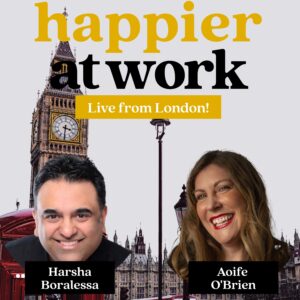
In this week’s episode of the Happier at Work podcast, recorded live in London at the launch of Thriving Talent, Aoife is interviewed by Harsha Boralessa, Founder and Host of “Reframe & Reset Your Career” Podcast. She explores the framework behind creating healthier, more effective workplaces. The discussion focuses on psychological safety, culture, individual drivers, capabilities, and leadership, with practical insights into helping people perform at their best.
In This Episode, You’ll Discover:
- Why psychological safety is the foundation of thriving workplaces, and how silence can reveal its absence.
- The importance of creating an environment where people can challenge ideas, speak up, and share concerns respectfully.
- How culture, drivers, capabilities, psychological safety, and leadership combine in the Thriving Talent framework.
- Why underperformance may signal a poor role fit, unmet needs, or unclear expectations rather than a lack of ability.
Related Topics Covered:
Power Dynamics, Neurodiversity at Work, Communication
Connect with Aoife O’Brien | Host of Happier at Work®:
Connect with Harsha Boralessa | Founder/ Host of “Reframe & Reset Your Career” Podcast:
Episodes You’ll Love:
Episode 226: The 3 C’s of Thriving Talent with Aoife O’Brien
Episode 318: Foster Thriving Teams: A Happier At Work Special
About Happier at Work®
Happier at Work® is the podcast for business leaders who want to create meaningful, human-centric workplaces. Hosted by Aoife O’Brien, the show explores leadership, career clarity, imposter syndrome, workplace culture, and employee engagement — helping you and your team thrive.
If you enjoy podcasts like WorkLife with Adam Grant, The Happiness Lab, or Squiggly Careers, you’ll love Happier at Work®.
Join Aoife O’Brien for weekly insights on leadership, workplace culture, career clarity, imposter syndrome, and creating work that works for you.
Editing by Amanda Fitzgerald.
Website: https://happieratwork.ie LinkedIn: https://www.linkedin.com/in/aoifemobrien/ YouTube: https://www.youtube.com/@HappierAtWorkHQ
Aoife O’Brien [00:00:01]:
Hello and welcome to this very special episode of the Happier at Work podcast. I’m your host, Aoife O’Brien, and this episode was recorded live in London at the London launch of the Thriving Talent book. And I’m interviewed by Harsha Boralesa. He asked me questions about the book and my own journey, and I really hope you enjoy today’s episode. Welcome, everyone. to this live recording of the Happier at Work podcast, live in London in the Personio office. Welcome. This is— I was going to say, how many times have I done this? I’m not sure.
Aoife O’Brien [00:00:38]:
But we’re here recording this live to celebrate the London launch of my book, Thriving Talent, and I’m being interviewed by Harsha Baralasa.
Harsha Boralessa [00:00:47]:
Well, I suppose the first thing, Aoife, before we sort of get into the book itself, So why, what was the motivation for you writing the book? And would you write another one? Because I think writing a book for, you know, is a tough thing and it’s like, I suppose, giving birth in a way. Yeah.
Aoife O’Brien [00:01:04]:
I
Harsha Boralessa [00:01:04]:
maybe worse.
Aoife O’Brien [00:01:05]:
I was about to equate that. Now, I don’t have kids myself, but from stories I hear, once you’ve had a kid and then you want another one, it’s as if you’ve forgotten the entire thing that happened before. And that’s why you have another child. And I think writing a book is probably the same. So you forget all the blood, sweat, and tears that went into writing it, all the hours that you spent doing it. But why this, why now? I’ve always wanted to write a book, like, as long as I can remember, and I always thought that that might be a novel, strangely. And over time, I remember actually at one point saying to one of my colleagues, in one of the offices that’s mentioned in the book but not named, let’s say, that I wanted to actually write a business book. And she sort of laughed or snorted or something, and I thought, oh.
Aoife O’Brien [00:01:58]:
And so, Laura, wherever you are, this is for you. So, yeah, so I’ve always wanted to write it, and I had some experiences at work that I talk about in the book. So I had some really positive experiences And then I had some really negative experiences, and I drew upon those experiences, and I went and I did a master’s in organizational behavior, and I did a lot of research, and I asked hard questions about what it means to be happy at work or what it means to fit in, to belong, and to really thrive. Answering those questions or asking those questions, I came up with this framework for creating what I first called the Happier at Work framework and came up with the title of Thriving Talent. And I really liked the title, by the way. I hadn’t finished the book, and I really liked that title. And I was writing and writing, and I kept saying, the Happier at Work framework, the Happier at Work framework, but in the Thriving Talent book. And I was like, it makes no sense now.
Aoife O’Brien [00:03:01]:
I think I need to change the name of the book or the framework. So I changed the name of the framework to be the Thriving Talent framework. But it looks at— I’m going to talk about the pillars first because this is what really came through from the research that I did. The pillars, it was values, needs, and I think abilities was the academic term. And I changed the language around that and I said it’s culture, drivers instead of needs, and capabilities instead of abilities. So that formed the basis. And then through conversations, through work that I’ve done with clients, I added 2 extra bits. So there was psychological safety as the foundation, and then leadership as the capstone that holds it all together.
Aoife O’Brien [00:03:50]:
So we have to have psychological safety at work to do any of these, to put any of these changes in. And then we have to have strong leaders in place to be able to execute across the 3 pillars and to create psychological safety to begin with. So that’s a very long-winded answer to say, why did I write the book? I felt like I had an important message to share about how to fix all the things that are broken with work.
Harsha Boralessa [00:04:18]:
On psychological safety, did you have Amy Edmondson on your podcast?
Aoife O’Brien [00:04:22]:
I did have Amy Edmondson. Why, thank you for asking. It’s as if I paid. No, I actually didn’t. This was surprise. I did. I did. Yeah.
Harsha Boralessa [00:04:30]:
Yeah. Do you wanna share some insights from her? Because, I mean, obviously, you know, the mother of psychological safety.
Aoife O’Brien [00:04:36]:
I could talk about this stuff all day. I met Amy Edmondson at a conference in Paris last year, and I think it was maybe the day before I was going to the conference, and I looked up, like, what’s the agenda? What’s actually happening? And saw that she was speaking and signing books. So I made the most of the opportunity. And when they asked people, do you have any questions for Amy? My My hand was straight up so that when it came to the crunch, she would know who I was. So I asked a question, and then she was signing books afterwards. And I said, you know, Amy, I actually have a podcast called Happier at Work, and I’m currently writing a book called Thriving Talent, and I’m drawing upon all of your research on psychological safety. And she goes, oh, I think we need to talk. So she gave me her email address, and I reached out, and she came on the podcast.
Aoife O’Brien [00:05:30]:
And she also very kindly endorsed my book. Andrew knows. Andrew’s here tonight. He knows. That was hard won and very—
Harsha Boralessa [00:05:38]:
That’s not easy to get.
Aoife O’Brien [00:05:39]:
Not easy to get. Very last minute. Oh, I’m looking at Isabel here. Isabel was the one who was right beside me when this was all going down, taking pictures and chatting with Amy herself about acting and how that relates to psychological safety. But yeah, that was hard won and it came in sort of, let’s say, just in time, just before things really needed to be ready to be printed. So I think I woke up from a nap in Tenerife and read my emails, as I do, and there it was. And I couldn’t believe it. I was absolutely thrilled.
Aoife O’Brien [00:06:18]:
What have I learned from her in relation to psychological safety? There are so many things that people get wrong about it. One of the things she said is not having psychological safety is the default. So we assume that we have psychological safety, but actually we mostly don’t. And we assume that because people are silent or they’re just kind of nodding, but they’re not really saying anything, that they’re agreeing with us, and they’re not. Like, how you know you have psychological safety is when people are pushing back. When they’re challenging you and they’re speaking up and sharing ideas. And how you know you don’t have it is when there’s silence, basically. You know, there’s the way I see it, and she talks about this, is on the one extreme, we can say psychological safety means we’re comfortable and we can say whatever we want, but actually it’s about having candor as well.
Aoife O’Brien [00:07:19]:
So it’s not just about saying what you want, it’s about being respectful as well. And then on the other extreme, yeah, it’s not about just saying like, this is what I think, no holds barred. We have to have that little bit of respect for people as well. I mean, there’s so much, like, there’s an entire section on psychological safety in the book. And the vast majority is citations from Amy Edmondson’s work. So yeah, it really is incredible.
Harsha Boralessa [00:07:51]:
Because I think that that’s such an important thing that you’re in those meetings, say, with your boss or your team, and people are very loath to speak up.
Aoife O’Brien [00:07:59]:
Yeah.
Harsha Boralessa [00:07:59]:
But if you can create an environment where people do feel safe to actually push back on the boss, and especially if he starts speaking first, nobody’s gonna disagree with it.
Aoife O’Brien [00:08:08]:
Exactly.
Harsha Boralessa [00:08:09]:
It’s a career-limiting move.
Aoife O’Brien [00:08:11]:
Yeah. The power dynamic is one of the really interesting things. So if the boss speaks first, then there’ll be agreement with the boss, and we’re very reluctant to speak up to the boss. In the book, I talk about— and this is, you know, it’s taken from TV, so it’s not real, but it’s total satire, if you like. Has anyone seen the show Silicon Valley? Show of hands. Yeah. Yeah, a few people. Okay, so there’s an episode with Gavin Belson, and he’s announcing this product launch, and product launch, he says, it’s coming in 2 weeks.
Aoife O’Brien [00:08:42]:
The team see him on this big screen making this big announcement, and someone says, did he just say 2 weeks? We’re more like 6 weeks. And someone else hears them and says, did you say 6 weeks? We’re more like 15 weeks. And so each person doesn’t want to communicate the bad news back up the ladder. Another really interesting thing, I don’t wanna make this all about psychological safety, But is this idea of impression management. So we don’t want to upset people, so we manage what they think of us. We don’t want them to think badly of us, so we don’t say bad things to them, or we don’t challenge them because we want them to like us. So I think that’s another interesting part of it as well.
Harsha Boralessa [00:09:29]:
Brilliant. So what’s the key thing you want people to take away from this, and how can they put it into action at work?
Aoife O’Brien [00:09:37]:
I think so. Overall, the book is about creating the conditions around people. I think so often we focus on individuals and how do you make someone perform better, or how do you make someone more resilient. And this talks about the environment that creates the performance that they have. So rather than saying, that person needs an intervention individually. It’s thinking about what can we do collectively to create this environment where people can perform at their best. And I mean that on— and also on an individual level. So understanding what the individual needs or what their unique strengths are that they bring to the table, creating psychological safety for them, understanding their values and how their values link to the work that they’re doing.
Aoife O’Brien [00:10:26]:
So I think generally that’s what it is. But we’ve talked quite extensively about psychological safety. And I think if I tell anyone where to start with this stuff, it is psychological safety. That’s at the very foundation.
Harsha Boralessa [00:10:39]:
And it’s interesting because I suppose some people may be performing, some people may not be. And I suppose it’s up to the boss to really drill down, take the time to really understand, as you’re saying, where those skills are, where their strengths are, and try and major on those.
Aoife O’Brien [00:10:55]:
Yeah.
Harsha Boralessa [00:10:56]:
Any thoughts or practical tips on
Aoife O’Brien [00:10:58]:
Yeah. So I think we do tend to focus— let’s take that example of performance, and we have someone who we think is a performer and then someone else who’s not. But you have to think what’s causing that performance. And I think what we tend to do is say, that person’s just— they’re just useless, or they need training. You know, we kind of write people off either as being not that good or a difficult person because they’re not doing what they’re supposed to be doing. And instead, my challenge is thinking about, are they in the right role? So are they utilizing their capabilities? Like, maybe they’re in the completely wrong role for them. I know I’ve been in that situation myself, so I know what it’s like. I deliberately chose a role where I wasn’t really using my capabilities to the best of my abilities.
Aoife O’Brien [00:11:49]:
And for anyone who knows me, one of my values is excellence. Like, if I’m working I want to do something really— I was about to swear there and I won’t— really fucking well. Like, if I’m doing something, I want to do it well. And that role didn’t give me the opportunity to do that. And I felt I was struggling, maybe not performing, and my boss could see it as well. So I think people know when they’re not performing, but it’s about understanding that. That’s kind of one aspect. But the other aspect is about need satisfaction at work.
Aoife O’Brien [00:12:20]:
And this, again, from my master’s research, so interesting understanding what people need to be able to perform. Things like autonomy, but having the right balance of autonomy. So not too much autonomy, but not too little autonomy either. And the only way you can know that is by having a conversation with someone. And they won’t know probably the words to use. They won’t know about what their needs are, but they very likely know what’s stopping them from from performing, saying, well, you’re breathing down my neck and you’re telling me what to do and just leave me to my own devices. So that’s like one example of a need. And we have 3 universal psychological needs that we all have.
Aoife O’Brien [00:13:01]:
And then, you know, to top it all off, we also have unique needs that we all have that need to be satisfied for us to perform at our best as well.
Harsha Boralessa [00:13:10]:
And it’s interesting, that whole idea of like a micromanaging boss or somebody who gives a lot of leeway, but sometimes you don’t want too much leeway, otherwise there’s chaos.
Aoife O’Brien [00:13:19]:
Yeah, exactly.
Harsha Boralessa [00:13:20]:
So it’s having that right balance between getting the specific tasks done and giving a bit of leeway. I mean, what do you think, Aoife?
Aoife O’Brien [00:13:28]:
Yeah, totally agree. Hands up who’s ever had a micromanaging boss. Yeah, so like nearly everyone in the room has put their hand up, and it doesn’t surprise me. And I think sometimes we’re so afraid of being that micromanaging boss, that we tend to leave people to figure things out on their own. But what we really need to do is give people clear direction and guidance about what they need to do. Like, what is the expectation here? What’s the really clear expectation? And also give people permission through psychological safety to ask and to speak up and say, you know what, I’m not really clear what’s expected here. But in a way that doesn’t make them feel like they’re incapable of doing their job. So what I mean by that is, you know, asking, what does success mean in this situation? Or what kind of outcome are you looking for with this? Rather than saying, what’s the expectation? And because I think when we ask those questions, it makes us feel like, I don’t— I should know this, and I feel like I’m incapable of doing my job if I have to ask how to do the job.
Aoife O’Brien [00:14:35]:
So making it safe for people to ask those questions, I think, is really important. When I talk about expectations, I usually talk about time and quality. So time being, if there’s a deadline associated or around how much time there is. But one of the things I talk about is Parkinson’s Law, where work will fill the amount of time that you allocate. So you can give something 2 weeks, and then you’ll take all of that time to do the work, and you’ll be perfecting and all of that kind of thing. So if you set a clear expectation and say, well, this should probably take about 2 hours, then allow 2 hours for it. And then over time, maybe that will go down to 1 hour. I’m using kind of basic maths here because I’m on the spot, I’m on stage.
Aoife O’Brien [00:15:23]:
But yeah, that would be my thoughts around that.
Harsha Boralessa [00:15:26]:
And one thing that sort of strikes me from what you’re saying, Aoife, is that it’s down to relationships and the relationships you have with your peers and your boss. And if you do have a good one, then I think the communication both ways can be very honest.
Aoife O’Brien [00:15:42]:
Yeah.
Harsha Boralessa [00:15:43]:
Whereas if there’s, um, uncertainty or there’s a strain, then people will be reluctant to speak up.
Aoife O’Brien [00:15:50]:
Yeah.
Harsha Boralessa [00:15:50]:
And you’ll also be reluctant to give honest feedback. Yeah. What do you think, Eva?
Aoife O’Brien [00:15:55]:
Totally true. And can I give a shout out to Jeremy, who I met 2 days ago at an event? He’s How’s the mic? He talks about this stuff in relation to relationships at work, so just wanted to give you a shout out. We had a great conversation the other day about how these things show up at work. One of the things I wanted to say on that is this idea of care and respect. So this comes up a lot, like what if there’s someone in your team you just don’t really get along with them or you don’t actually like them? And you don’t have to like someone to respect them and to, you know, to give them care and to care about their well-being. You don’t have to like them. And I think, you know, I’ve done that as a boss where you’re like, I actually prefer chatting with Darren than I do with Niamh, so I’m gonna chat with Darren a bit more and have a better conversation with him. But I think we need to be aware of those things as bosses, that we can’t have those biases.
Aoife O’Brien [00:16:49]:
And you don’t have to like everyone to care and to show you care and to be respectful to people as well.
Harsha Boralessa [00:16:56]:
And I think if you’re thinking about the mission and the overall benefit to the team and the project, then it’s easier not to worry so much about personal relationships in the sense of you don’t have to like everybody, do you?
Aoife O’Brien [00:17:10]:
Yeah, I think you have to— you don’t have to like everyone, but you should have a professional respect for someone on the assumption that they’re performing and that, you know, that they’re not being a jerk, basically.
Harsha Boralessa [00:17:22]:
What happens if you do have a colleague who you’re not getting on with, or as a manager, you have somebody who’s just being difficult.
Aoife O’Brien [00:17:29]:
Yeah.
Harsha Boralessa [00:17:29]:
Any tips for our audience about how they can deal with that?
Aoife O’Brien [00:17:33]:
It’s a really hard one because I know the answer as a human of what I want to do in that situation, but I also know the answer as a leader, which is slightly different to our default, like, I don’t want to deal with this, or that person is just being a jerk and I want to get away. And I had this conversation on a podcast not too long ago where Usually, if someone’s being difficult and they’re labeled as being difficult, it’s probably because one of their psychological needs is going unmet. So it’s about understanding what need in that person is going unmet for them to act like such a jerk. And just having a conversation with someone and showing some care and showing some respect and killing them with kindness, I think, can help to understand what’s really going on beneath the surface. And to use a bit of an anecdote, I did hear some, you know, someone in a hospital situation came into an emergency room and was saying he was just being a jerk. I don’t want to use any too strong language, but let’s say he was being a jerk and making demands and things like that. And it all it took was one person to say, How was your day? Or, is everything okay? Or, what can we do for you? That changed the entire situation. He said, you know what, I’ve actually had a terrible day, and this has happened, and that has happened.
Aoife O’Brien [00:18:57]:
And it just takes one person to make that connection with someone, I think, for them to open up and say what’s really going on. Because I’ve been that person as well. And recently, you know, and I’m noticing more and more, you’re overtaken by emotion, and you’re like, I’m— this is what I want to do and what I want to say. And it’s about catching yourself, I think, in that moment before you have that emotional reaction and choosing to respond rather than react. And it’s so much harder to do it than it is to talk about it because I’ve had it just recently and I’m like, oh, what is— what’s going on here? And how do you get out of that? And you get hijacked. I’m not going to go into all the brain science because it’s not my area of expertise, but you basically get hijacked by your emotions. if you let them.
Harsha Boralessa [00:19:47]:
Yeah, it could be the other person’s just insecure and they like the sound of their own voice, but they’re not doing it to be unpleasant. That’s just the way they are. So if you can, like, de-escalate the situation, that can help.
Aoife O’Brien [00:20:00]:
Or a lack of self-awareness. Like, in the leadership chapter, the entire first half of the leadership chapter is all about how we lead ourselves and understanding the emotions and understanding all of these things that get in the way becoming a more conscious leader, understanding our emotions, growing in self-awareness. And some of the stats around self-awareness are crazy. So 95% of us think that we’re self-aware, but only— and who here thinks they’re self-aware? Yeah. But the reality is it’s more like 10 to 15% of people are truly self-aware. So just think about that. And self-awareness is not just about Your knowledge of yourself. It’s about your knowledge of the impact that you have on other people and how they behave in response to you as well.
Harsha Boralessa [00:20:54]:
Because that’s a really interesting point you make about the impact, because I think especially as leaders, whatever you say has an outsized impact on the team. And sometimes a throwaway remark you make, which you think is a joke, actually it can trigger other people.
Aoife O’Brien [00:21:09]:
Yeah.
Harsha Boralessa [00:21:09]:
You do need to be very careful about what you’re saying. Do you want to expand on that?
Aoife O’Brien [00:21:13]:
I have a funny example of this, and I can’t recall where I heard this initially, but I thought it was kind of funny. So a CEO was going into these meetings regularly, and he noticed that they always had bananas. And he’s like, after a few months of always having bananas, he asked someone, Why do we always have bananas here? And they said, oh, oh, well, the first meeting that we had with you, you said you like bananas. And he probably made a throwaway comment saying, oh yeah, I like bananas. And then every single meeting thereafter, hey, lo and behold, we’ve got some bananas. So I think as leaders, we do need to be aware. And I was working with the team a number of years ago, And the CEO of the team had this impact as well, and she didn’t realize. So she would say something kind of flippantly almost, or, this is what needs to be done.
Aoife O’Brien [00:22:17]:
And how the team took it up was, you know, that word is now— that’s what’s been said, that’s what has to be done, whereas she was just making a remark. And I think we need to be aware of that as leaders. And I do talk about that, having just read the book. I do talk about it several times. The shadow that leaders cast is much wider than they think, and the higher you go in an organization, that perceived power differential— people listen disproportionately to what you say. So you have to be really careful about what you say, even in those throwaway remarks or comments about a person, what you want to do, whatever it might be.
Harsha Boralessa [00:23:01]:
Because somebody I was interviewing made this point about he used to send emails at midnight because that was his— no, but that was his working style. But he wasn’t trying to put pressure on the team.
Aoife O’Brien [00:23:11]:
Yeah.
Harsha Boralessa [00:23:12]:
But simply, like, an idea came up, he sent it out, but the people he was sending it to, they were freaking out.
Aoife O’Brien [00:23:17]:
Yeah, that’s role modeling at its finest. So you can say everything you want— I support well-being, don’t be working out of hours— but if you’re the one who’s sending emails at 12 midnight then that’s what your team is going to see. They’re going to imitate your behavior. They’re not going to imitate what you say because they’re just going to imitate what you do.
Harsha Boralessa [00:23:37]:
Yeah. What can stop leaders from taking action on the learnings from your book? Any thoughts on that, Aoife?
Aoife O’Brien [00:23:44]:
I think not reading the book in the first place. So get it into as many hands as we can. I think, like, for me, there’s a lot in there. And I admit that, like, it’s a big book. There’s a lot of content in here, and there was a lot I had to say. There was a lot that we didn’t include in it as well. But the very foundation is psychological safety. Coming back to this idea full circle, back to psychological safety, you have to have that.
Aoife O’Brien [00:24:14]:
You can’t just jump in and say, oh, I think we need to do a culture transformation, or we need to do work on our culture. You have to have the psychological safety in place. so that it is a success. I mean, I’d love to know in other people’s experiences, if you don’t have psychological safety, do you think that you can achieve the success that you want, like a culture transformation, for example? That could be something that stops people from implementing some of the learnings from the book.
Harsha Boralessa [00:24:45]:
Yeah, and I think with culture, it’s one of those things which does take time. You have to invest in it. You have to get your team to invest in it. But it’s not easy. And also, when it’s broken, sometimes it can be irreparably damaged. Any thoughts on that?
Aoife O’Brien [00:25:00]:
I think it’s so hard to rebuild trust. And again, I share an example of this in the book of a toxic work environment where someone shared with me, and I don’t name the company in the book, but he shared with me that he came in and It was just toxic. Like, he said, there’s no other way to describe it. It was very closed door, so decisions were being made at senior levels that were impacting people who worked in this call center, and they had no say in that. And he came in, and one of the first things he did was get them involved in the decisions. And it takes time to rebuild that trust. Like, can I trust that something’s going to change if I speak up? Can I trust that you’re going to, you know, keep your word and make the changes rather than what the previous ones had done? Now, some leaders didn’t like that. They didn’t like the new way of working.
Aoife O’Brien [00:26:00]:
They didn’t like this, oh, now we get people involved in the decisions. And so they decided to leave.
Harsha Boralessa [00:26:07]:
But that’s usually because it’s more work for them. It’s harder, and they have to justify what they’re doing.
Aoife O’Brien [00:26:12]:
Well, they liked having their own little you know, fiefdom or whatever you want to call it, you know, they liked having that sense of power and control, whereas this new way of working was much more collaborative and they, they didn’t really like that.
Harsha Boralessa [00:26:27]:
Well, I suppose it’s like that working from home and working in the office, that you feel if you’ve got your people in the office you can spy on them, and then you’ve got absenteeism and all these sort of silly issues. Okay, but ultimately if you focus on productivity, meeting targets. If you can crack it out in a few hours, then why can’t you go home early?
Aoife O’Brien [00:26:47]:
Exactly. Oh, I mean, we could do a whole other podcast episode about just this topic. I do talk about this in the book, the idea of presenteeism. And just because you’re in the office doesn’t mean you’re actually getting any work done. And anyone who’s been in an office sitting beside someone who’s scrolling through Facebook knows that. But this idea of productivity, so interesting. I’ve been interested in it as long as I can remember. And for me, a real shift needs to happen at work where we’re focusing on outcomes rather than inputs.
Aoife O’Brien [00:27:22]:
Like, it’s not about how much time you spend at work. It’s about— unless you’re billable hours, so I’m conscious of that because I have worked in that kind of environment as well. But I do see a shift happening there. It’s to outcomes. Like, what are the outcomes and how valuable are the outcomes that we’re delivering? to clients. And it is a shift in mentality. And like that, if you’ve achieved everything, then you should be able to go home, and we should be allowed to focus on rest and things like that. You know, I thought this was me in my own business.
Aoife O’Brien [00:27:51]:
My work is never done, and I enjoy it so much that I can keep going and keep going and keep going. But I have to stop myself and say I can’t. But it’s not just me. I know this exists in corporate as well because There’s— your list can just, you know, you can just keep going.
Harsha Boralessa [00:28:08]:
And it’s interesting talking about outcomes, I suppose, for the individual. If you’re in an environment where it’s difficult to say, like, what, uh, I’ve actually contributed— because say if you’re in finance, you can say, well, I’ve made this number of sales, or I’ve made this amount of profit— whereas in some, some jobs it’s not as easy to identify that.
Aoife O’Brien [00:28:27]:
It’s much harder because it’s about creativity and relationships and learning and development. And that’s why it’s hard. It’s really challenging to kind of have proof that you’ve actually done quality work or that you’ve produced something because maybe you haven’t. So it is hard, and I think it comes back to clearly, really clearly defining why do we exist, what are we actually doing here in the first place.
Harsha Boralessa [00:28:57]:
I suppose in a way it’s having that conversation with your boss. to say, I think this is what I can produce and these are the milestones, and having that clarity. Because otherwise it’s just very difficult, isn’t it, to say, uh, if you’re not in a, like, a sales role or something, what have I produced, or what are the deliverables, or what is the product? So being very clear with the boss, because the worst thing is doing like 6 months and then there’s a complete, um, miscommunication about what should have been achieved.
Aoife O’Brien [00:29:26]:
Exactly. Goes back to expectations again. If anyone has a question, we have a roving mic going around. Oh, oh, there’s some brave people with their hands up. This is great.
Orla O’Brien Davison [00:29:38]:
Thank you for your book. I’m really looking forward to listening to it. And I’m really interested when you’re talking about psychological safety. I’ve seen a lot of work situations where there’s— I’d call it trust personally— and watched the effects on people. so on and so forth. What I wonder about is, um, given the new kind of opening up of research and knowledge in the area of neurodiversity, considering the average amounts of people you’re going to have within a certain cohort, how do you see leaders who’ve come through a life of neurodiversity where they’ve always had to try and fit in And all of a sudden, to be a leader, you need to stand out. And if you spent a long time trying to mask and shape-shift in order to fit into a certain shape, to go back outside of that, it goes against everything you’ve known.
Aoife O’Brien [00:30:43]:
Yeah.
Orla O’Brien Davison [00:30:44]:
And we are losing so many people with such incredible skill sets. And that, that’s what I, I wonder about. How do we, how do we tackle that? Because actually, if you don’t have trust, you don’t have connection, and if you don’t have connection, you don’t get work done.
Aoife O’Brien [00:31:02]:
What I see is a lot more people talking about it, understanding it. I don’t have a diagnosis myself, but I do suspect, um, I went for like an introductory call, and I know there’s a lot of people here. I don’t want to name names, but I do know that there are people here tonight who have ADHD or a mix of autism and ADHD. But I think there’s a lot of awareness being raised about it and the specific skills that people have when their brains are different. I think there’s no easy answer, just, I mean, education and show people those kind of statistics. Like, that would be my approach. Matt, I saw you raise your hand as well. Is there anyone else? Stick your hand up quickly.
Aoife O’Brien [00:31:46]:
Or are we all okay? We’ve got a couple of more questions.
Matthew Cook [00:31:50]:
Hey, I’m really fascinated about the culture pillar, and particularly your final point around output focus, because for sure, I would agree with you in principle, both of you, around focus on output. If you’ve got the work done, why do you need to count the hours? I’m curious about what gets lost as the invisible inputs. So, you know, certainly seeing over the last 5, 6 years, especially with hybrid, with AI, connection is being lost. We kind of traded more autonomy, less connection. The working relationship is much more transactional. We’ve lost those interstitial moments between meetings where actually was where you got to chat and find out what people are thinking. It’s right onto the next Zoom call. And I’m curious how we balance the output focus without losing what we really need to be intentional about, which are those kind of invisible cultural connectors.
Aoife O’Brien [00:32:43]:
That’s such a good point. So for me, it’s outcomes rather than outputs. So outputs being probably the result of what you’re doing, outcomes being this is what we’re here to achieve and this is what has been achieved. So a slight difference, but then I love that point of inputs because, well, I always think of inputs as the time, the energy, the resources that it takes to create work. But actually, that piece that you’re saying, that connection piece, it’s really the missing piece as well, especially when we’re working in hybrid. I don’t have direct experience of that because I work for myself, but I do really miss that being in a team environment. That’s something I really miss about working for myself. I would say trying to get that back, I don’t think you can force it.
Aoife O’Brien [00:33:37]:
You can just acknowledge that people are lonely and people need to connect. Like, it’s one of our fundamental needs at work. One of the needs I talk about in the psychological— like, in the driver section— is relatedness. And that is a sense of connection with the people that you work with. And that’s one of the fundamental needs that needs to be satisfied in order for us to do our best work. So I think if people are aware of that, and I think oftentimes with this, you’re not aware of it until it’s too late, and you don’t realize how lonely you’ve been or how much you’ve missed being in that environment. So I think just bringing it to people’s awareness and saying, actually, that is how I’ve been feeling, and giving them permission to reach out just for a chat. It doesn’t have to be about work, but just to connect.
Aoife O’Brien [00:34:28]:
with other humans. I think that’s, to me, how I would approach that. Bhushan, I know you had a question, and I think Kelly, and maybe we leave it there.
Bhushan Sethi [00:34:36]:
Aoife, very proud to be here at the front, sitting here with my daughter for the London launch. As you’ve presented this around the world or on multiple continents, what’s similar or different?
Aoife O’Brien [00:34:46]:
I think there are similar challenges. Like, I didn’t focus a huge amount of what I wrote about in the book on AI, But I did a tour around the US. So Bhushan very kindly hosted me at PwC in New York for the, the New York launch or for the US launch. And I did a trip then for almost 6 weeks around the US having conversations with leaders there. But AI was something that came up again and again, and not in the context of AI being something to fear, because I don’t think people were afraid. They were just trying to understand How do we better use this? Or like, what does this actually mean for how I get my work done? As opposed to, I’m so afraid that AI is coming for my jobs. So that’s something I think that came up. I sort of feel sometimes that the US is— and again, feel free to challenge me on this— but I feel like the US is way ahead of the rest of the world on this.
Aoife O’Brien [00:35:43]:
Now, someone else said to me they think the US is actually behind. in some, in some aspects. For me, I think sometimes because I have, um, conversations with people from all over the world and it has a global audience as well, the podcast has a global audience, but some of that audience are based in Ireland. And sometimes I feel like I talk about stuff that they’re just not ready to hear. They just don’t really get it. And Kelly, I think, had a—
Kelly Hartman [00:36:10]:
Yes, thank you for having me here. I feel very humbled, given that I remember our first podcast during COVID But my question to you is, like, I’ve been in, um, as you know, I’ve been in a lot of startups, right? And, um, I was discussing with Alice before the different levels of leadership. And I’ve recently interviewed for quite a lot of roles. And, you know, in some situations, like, psychological safety is bullshit. We don’t really care what people think because it’s data. And then I left the process. Yeah. But there are a lot of leaders like that, especially in startups.
Kelly Hartman [00:36:45]:
You have time. You’ve got to hit the ground running or you’re out because if you’re not making revenue and things like that, how do you challenge those leaders? Like, that’s— how do you— like, and you said just before, some people are not ready for it. I think there’s a lot that just don’t really care. How do you challenge that?
Aoife O’Brien [00:37:02]:
No, such— I think it’s such an important question, and I see that a lot, especially with startups. And I had this on a podcast I was on not too long ago, and they really pushed me on this idea of psychological safety. They really did not like that term, and they were like, I’m not getting it. And they get pushback. They are consulting with startups, and they get pushback on that term. We don’t like psychological safety. We don’t want to use that term. And to me, the reason it’s at the start of the book is because it’s fundamental.
Aoife O’Brien [00:37:36]:
If you want to tell people that you don’t give a shit, you have to have psychological safety to be able to do that. So maybe they have created psychological safety because they can do that. But if they’re burning people through the ground, you kind of have to do the maths on it. Like you said, Kelly, like, you have to look at how much it’s costing you. So the research shows that it costs between 30% and 200% of someone’s salary when they leave an organization. So do the maths on that. And if you need to replace someone, on a regular basis, if you have an attrition rate of 50%, you can easily put the numbers around it and say, so that person brought in this amount, or this is what we’re aiming for, but actually, this is how much we’re losing because we’re churning through people so frequently. So for me, maybe if they don’t like the term psychological safety, just give them a different language to use because it seems to have Especially in startups, it seems to have this kind of negative connotation for some reason.
Harsha Boralessa [00:38:38]:
But who’d also want to work in an organization like that?
Aoife O’Brien [00:38:41]:
So, I mean, this again, this could be a podcast episode for a whole other day, but if you’re in that kind of cutthroat environment and you really thrive in that, that’s one thing. But if you build a reputation for burning people out, who is actually going to choose to work there? And there are exceptions. I think if you have a really good brand and people are associating your brand with, if I have this on my CV, then I can get a job anywhere, that’s one thing. But you kind of have to look at the cost in the longer term. And again, we tend to focus so much on short-term and keeping shareholders happy and short-term wins at the expense of long-term gains. I think we’ll wrap it up there. Thank you so much for your engagement. I’m here if you have any questions.
Aoife O’Brien [00:39:32]:
I’m here. And now it’s time for wine, I think. So thank you.
Harsha Boralessa [00:39:36]:
Thank you.
Aoife O’Brien [00:39:42]:
That was the live recording of the Happy at Work podcast at the Thriving Talent launch in London. I really hope you enjoyed today’s episode. It certainly was a fantastic event in person to be able to connect with people in such a way. So I’m really glad I did that. And if you’re interested in joining me for a live event in the future, make sure that we are connected on LinkedIn, that you’re on my mailing list, and hopefully I will see you sometime soon.
