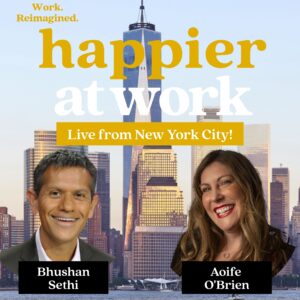
How can leaders and organisations create truly thriving and happier workplaces in today’s ever-changing world?
In this milestone 300th episode of the Happier at Work podcast, recorded live at PwC in New York, host Aoife O’ Brien swaps seats and answers insightful questions from Bhushan Sethi about her new book, “Thriving Talent.” Together, Aoife and Bhushan dig into practical ways individuals and organisations can drive performance, foster well-being, and build resilient cultures where both people and business results thrive, even amid global disruption, generational shifts, and the rise of AI.
In This Episode, You’ll Discover:
- The importance of setting clear expectations and frequent feedback for performance and well-being
- Why thriving workplaces benefit both people and the bottom line, supported by research showing significant gains in profitability, engagement, and retention
- The difference between “being nice” and true kindness as a leadership strength
- Understanding the cost of turnover and the business case for investing in people
Related Topics Covered:
Cost & Turnover, Transparency at Work, Thriving Talent
Connect with Aoife O’Brien | Host of Happier at Work®:
Connect with Bhushan Sethi | Partner at PwC:
Related Episodes You’ll Love:
Episode 50: Bhushan Sethi on the Future of Work
Episode 150: Navigating the New Business Landscape with Bhushan Sethi
Episode 200: Reskilling Diversity and Building a Happier Workplace with Bhushan Sethi
Bonus Episode: Bhushan Sethi on Building a Happier Workplace
About Happier at Work®
Happier at Work® is the podcast for business leaders who want to create meaningful, human-centric workplaces. Hosted by Aoife O’Brien, the show explores leadership, career clarity, imposter syndrome, workplace culture, and employee engagement — helping you and your team thrive.
If you enjoy podcasts like WorkLife with Adam Grant, The Happiness Lab, or Squiggly Careers, you’ll love Happier at Work®.
Join Aoife O’Brien for weekly insights on leadership, workplace culture, career clarity, imposter syndrome, and creating work that works for you.
Editing by Amanda Fitzgerald.
Website: https://happieratwork.ie LinkedIn: https://www.linkedin.com/in/aoifemobrien/ YouTube: https://www.youtube.com/@HappierAtWorkHQ
Mentioned in this episode:
Thriving Talent book – out now
Aoife O’Brien [00:00:01]:
Hello, and welcome to this very special episode of the Happier at Work podcast. I’m your host, Aoife O’, Brien, and this is episode 300. And this episode is extra special because it was recorded live in front of an audience at PwC in New York, which was part of the US launch of my book, Thriving Talent. And we’ve switched things up a little bit this year. So my guest, Bhushan Sethi, he’s been on episode 50, 100, 150, 200 and 250, and this time we put him behind the mic and me answering the questions about Thriving Talent. Because it was recorded live, the sound quality is not what you’re used to. So if you’re new here, this is not our standard sound quality. But I really hope you enjoy the episode nonetheless.
Aoife O’Brien [00:00:49]:
And do let me know what’s one thing you’re going to do differently after listening to today’s episode? Hi, everyone. We are here live from New York, my favorite city in the world, talking about doing this for two, three.
Bhushan Sethi [00:01:01]:
Longer.
Aoife O’Brien [00:01:02]:
Longer. Okay. Probably since we first met, I was like, one day we’re going to do this in person. And when I imagined in person, I imagine some studio in New York or something. What it’s turned out to be, you know, coincide with the launch of my book. So we’ve turned it into, like a live podcast in front of all of these people. You can’t see them if you’re watching on YouTube, by the way, talking about the book. And, yeah, some insights around happiness at work.
Aoife O’Brien [00:01:26]:
So we’re doing something a little bit different this time. I think I’ve done this once before, before where someone else has interviewed me on my own podcast that wasn’t live. This is going to be live, so it’s a little bit different. Up to now, I’ve always been the one asking you questions, and now Baton has handed over very firmly to you to ask me some questions. Do you want to introduce yourself?
Bhushan Sethi [00:01:47]:
Yes. Well, welcome to New York. Aoife Bhushan Setti, PwC. Delighted to be back on episode 300 of your podcast. We do have a live audience. Let’s talk about the book. Aoife, we’re so delighted that New York is the first stop of your US Book tour, but what does it mean, first of all, like, why did you write this book about Thriving Talent? What was the need to write about? There’s a lot of books out there. You’ve got 300 podcasts out there.
Bhushan Sethi [00:02:11]:
You write a lot already. What was the reason that you wanted to write this book? And who are you writing it for?
Aoife O’Brien [00:02:18]:
I had some experiences at work. I was always super, super ambitious at work and had some really positive experiences early in my career. And then later in my career I had some not so positive experiences. And this happened to me a couple of times. I started questioning myself, my work, my own abilities. The second time that this happened, second organization, I decided to leave and I went on and I did a master’s in organizational behavior. And that kind of opened my eyes to the possibilities, and it blended together my own expertise in data analysis, bringing those insights together, and the people side of business as well, which I haven’t really looked at before. And this is from my own personal experience.
Aoife O’Brien [00:03:02]:
The feedback so far on the book has been really positive. From the oh my God, I can see myself in this book. I’m reading this, and I can so relate to it. So I think it is something that’s needed. And for me, it’s based on the research I did as part of my master’s. But it’s also been an evolution in conversations, in the work that I do with my clients, and it’s all packed into this book. So I went quite broad with the book, but I went very deep in each of those very specific topics.
Bhushan Sethi [00:03:32]:
Having read the book, I appreciated it because I saw myself as an early leader and some of the mistakes I make continue to make. According to my colleagues. I saw myself now to say, how do I actually drive performance and productivity? And how do you do that with kindness? And can you actually have talent that thrives and becomes happier? But to what extent in today’s environment, with all the transformations going on and AI and all the polarization, is it realistic for us to have thriving talent to be happy at work?
Aoife O’Brien [00:04:03]:
I think so. I think from an individual perspective, we spend so much time at work, and if you go to work miserable, you probably come home miserable as well. And it’s impacting on all aspects of your life, it’s impacting on your relationships, on your health. From a business perspective, I think it’s really important to create that environment, not just because it’s the right thing to do. It’s shown to have an impact on the bottom line as well. So it’s not just quote from a oh, yeah, you know, we’re creating happier working environments. We’re creating conditions for our teams to thrive. It’s actually really important for business results as well.
Aoife O’Brien [00:04:40]:
And you know, I’ve seen people argue saying, oh, but there’s companies that exist where they don’t do all of this stuff. And they’re still really successful. It’s like, but how successful or how more successful could they be if they employed some of these techniques? We won’t know because they’re not doing that. Yeah.
Bhushan Sethi [00:04:59]:
So when we measure success in business profitability. We’ve talked about this before. The balanced scorecard isn’t so balanced. When you started writing this book and you started saying, how do we measure success around thriving talent, what did your
Aoife O’Brien [00:05:11]:
research uncover in terms of the kinds of results that we get? There is so much evidence out there to show that it. So Sean Acre has done a lot of work around this. I think he says it’s like 37% increase in profitability, there’s increase in sales, increase in revenue. Like it shows the numbers to me, they just make total sense to do that.
Bhushan Sethi [00:05:32]:
So this isn’t just us talent people being woke and saying we’ve got to like, we’ve got to be nice and kind so that we drive make people feel good.
Aoife O’Brien [00:05:41]:
And it’s not about just being nice and being kind. I think those words are sometimes used interchangeably when they’re slightly different. So I think being kind to someone sometimes means that you have to be hard, you have to be, you have to tell the truth. Be nice is trying to keep the peace and saying what people want to hear rather than what they actually need to hear. But that’s not really what it’s about. And I think, yeah, all the talent people can say, oh, this is what we should do. But if you can speak the language of leadership, if you can talk about money and, and metrics and things like that, then that goes a long way to getting this over the line. One of the really interesting things that I learned during the Masters is the cost of losing someone from the organization.
Aoife O’Brien [00:06:24]:
It’s cost 30%. Between 30% and 200% of someone’s salary. So for the easy math, let’s say you have someone on your team who’s earning $100,000 because we’re in America, $100,000. If that person leaves the team, it’s costing between 30,000 and 200,000 to replace that person. Between training, the ramp up time, the relationship cost all adds up. To hold on to people, we need to make sure we’re bringing the right people in to begin with.
Bhushan Sethi [00:06:54]:
So we want to hold on to people. We want to hire the right people. There’s a big role that leaders play here. Tell us about what the research has shown you and your stories around. Like what do leaders need to do well to drive great performance from Their talent.
Aoife O’Brien [00:07:07]:
For me, one of the best things that a leader can do is set really clear expectations. And if I think back to myself as a leader, if I think back to how I’ve been led, I’m not sure I’ve always had the clearest of expectations and I’d love to share a scenario with you that sometimes we are afraid to ask for clarification because we may have assumed that we understood what was being said. So we have an assumption, or maybe we’re not really clear, but we’re trying to figure it out in our head and we don’t want to ask because that will make us look incompetent. Like I don’t want people to think I can’t do my job, so I’m not going to ask for clarification. And so we spend time doing the wrong things. So for me, setting really clear expectations, making sure that communication is really clear and that everyone is on the same page. I just finished, I’ve just finished reading Dare to Leave by Brene Brown and she talks about this idea of rumbling. Like you always want to be rumbling with people and getting to the heart of the issue.
Aoife O’Brien [00:08:06]:
And some of the examples she used really resonated. So you have a conversation and someone says, I need this pain by 4pm and you’re like, I can’t do that by 4pm there’s no way I can do that by 4pm you get into a conversation, you try and understand, well, what is it that you actually need? What is it you’re trying to do? Well, I need this. Oh, well then you don’t need all of this. And if you want that by 4pm, I’ll get that to you by 3pm so just having a conversation about what’s required I think can take take away a lot of that unclarity lack of clarity and a lot of that takes it away. So I think that like setting those really clear expectations. But I think it’s really important to provide feedback to people. I think it’s kind to give feedback to people as well. I’ve.
Aoife O’Brien [00:08:51]:
I’ve been in situations where I’ve given feedback, maybe not in the best way, it wasn’t received in the best way. I’ve definitely learned from those experiences as well. But I think we need to be open to feedback as well and asking, actively asking people to provide us with feedback on how we are performing. It may be difficult to hear, but it’s really required for us to be able to grow.
Bhushan Sethi [00:09:14]:
And so leaders need to provide clarity. It’s Hard to provide clarity in a world of AI and disruption and polarization. Leaders need to provide good feedback. What if your boss. What if your people lead is not doing that? What’s your recommendations to people listening in on how they need to kind of push their bosses?
Aoife O’Brien [00:09:33]:
That’s a really good question, because sometimes we’re the ones who are not actually getting this question. Our leaders, I think we need to. We need to push. We need to ask for what it is that we need. I think we need to put the onus on us. In the book, I talk a little bit more about the different values that people have. I talk like one of the really interesting parts of it was around understanding people’s drivers at work and how we often assume that what motivates us is what motivates other people. And therefore we try and motivate people in the same way that we are motivated.
Aoife O’Brien [00:10:03]:
So if you have a leader who’s maybe not trying to motivate you or motivating you, or trying to motivate you in a way that you are not motivated, it’s worth having that conversation and having that language around what frustrates you at work. So in my career, I’ve had three terrible bosses. You’ll read about them in the book. No names shared, by the way, just in case. But, you know, part of that was micromanagement, and it is really difficult. It’s a difficult conversation to have if you’re being micromanaged. And I wish I had the language at the time to be able to explain that. But I think if you say it in a way where this is what is really frustrating me at work, this is what’s holding me back or blocking me from doing my best work, then I think people need to be open to that kind of feedback.
Bhushan Sethi [00:10:46]:
As we think about this and we think about workplaces, there’s a lot that leaders can’t control that could be the root cause of people’s lack of happiness. Lack of clarity. We’re in economic uncertainty. We have terrible wars. We have all kinds of uncertainty around what’s this technology going to do? What can we do as leaders or team members when there is a lack of clarity, but it’s beyond our control?
Aoife O’Brien [00:11:12]:
For me, it’s all about transparency. So no matter what the situation, even if someone asks you something and it is something within your control, but you can’t say anything or you can’t do anything about it, you still need to say, listen, this is beyond our control, and just have an open discussion. I know you’re a Huge fan of bringing these conversations out into the open. You know, just having those like this is the reality of what’s going on in the world today. This is happening outside of work, but it doesn’t. It still impacts us every day in work because we’re not reading the news and then checking ourselves at the door when we come into the office or when we open the laptop. We need to have these conversations. And so if there’s something that’s beyond our control as a leader, I think it’s, you know, the best thing we can do is, is acknowledge the fact that this is happening and be really open and transparent about it.
Bhushan Sethi [00:12:05]:
So we just need to be human and we need to listen.
Aoife O’Brien [00:12:07]:
Yeah.
Bhushan Sethi [00:12:08]:
When you started thinking about this book, we were post pandemic. Your experiences are pre pandemic. Somewhat argue workplaces and the way we think about our relationship with work and employees. Employees have changed post pandemic. How do you think this happiness topic has evolved? Kind of now we think about new generations, technology situations.
Aoife O’Brien [00:12:29]:
When I did the research for last year would have been during the pandemic. Actually, it’s when I did it. So I kind of overnight, obviously in March 2020, for anyone who doesn’t remember when that happened, I was at the stage where I was supposed to have started my dissertation already. I hadn’t started it yet, and I was looking to work with some specific organizations to do some research within them. And overnight that concept, that idea went away. So I had to do the research with individuals. So I got individuals from a broad range and I ended up with 200 and something, which is good for a master’s dissertation, by the way. I think the fundamentals of what I’m talking about haven’t changed.
Aoife O’Brien [00:13:13]:
And in the book, I wanted to kind of do an author’s note at the start to say, listen, this is a framework that has evolved over time. It’s based on the research I did, but it has evolved. But the fundamentals of what it represents are not going to change. The specifics within the framework may change, they may evolve, but the fundamentals of the shape of the framework are not going to change.
Bhushan Sethi [00:13:36]:
Are there any differences in good practice you’ve observed across either different industries, geographies,
Aoife O’Brien [00:13:42]:
size of companies in terms of creating this kind of thing? I mean, there are some really great examples. I cite some very specific organizations in some very specific areas. You know, especially relating to culture. For example, HubSpot is really well known for culture and I do a little bit of work with them sometimes as well. But yeah, like so there are some mentioned in there. There are some that do like, really, really positive things. What I really struggled to find was an organization that does the capability stuff really well. So again, you know, if anyone wants to chat to me afterwards about that, I’d be curious to know.
Aoife O’Brien [00:14:23]:
Have you experienced that? And by capabilities, I mean looking at people’s unique strengths that they bring to an organization and leveraging that and being able to put people working together who can leverage each other’s strengths. And then the drivers also, like, again, not that many people publicly talking about how do we understand what drives people at work and how do we make sure that we are motivating people in the right, in the right way? They need to be motivated. I think it was so much easier to find positive examples around leadership and culture rather than those other parts. On the psychological safety piece. I’ve had a conversation with Amy Edmondson on the podcast previously and she basically said that the default is that we don’t have psychological safety at work. We assume that we have it, but we don’t. So the vast majority of teams don’t have psychological safety. We assume because people are silent that we have psychological safety, but that’s actually the opposite of psychological safety.
Aoife O’Brien [00:15:22]:
So in terms of people who are doing psychological safety, well.
Bhushan Sethi [00:15:26]:
But it sounds like from the research that, and this consists of my own experience is the industry sector is an excuse. So what I mean by that is we’ll say, you know, I work in banking, it should be harder charging. I work in technology. It’s a different culture, but humans are humans. Whatever geography, whatever size of business we
Aoife O’Brien [00:15:44]:
owe that, I think people are drawn to specific types of organizations and specific types of roles. And then even within those organizations there will be very specific roles that lend to what drives an individual. Their values, their strengths, things like that. Like for me, and again, broad kind of brush strokes here, but in dealing with government agencies, very bureaucratic, very frustrating. I had an experience recently where I had to fill out a paper form and put it in a post. I was like, okay, so I haven’t had that kind of experience in quite a long time. And yeah, I just found it odd that in this day and age of technology that we would have to do something like that. And then you move over to the likes of technology and things are really fast moving.
Aoife O’Brien [00:16:31]:
They’re so fast paced and things happen quite quickly. So I think it’s just, it’s just kind of different depending on which industry you’re looking in and then within those specific roles as well.
Bhushan Sethi [00:16:43]:
Speaking of roles We’ve talked about leaders, we talked about colleagues in the workplace. A lot of your listeners are HR professionals, learning professionals, leadership development. What’s your advice for them? What’s their role in this?
Aoife O’Brien [00:16:54]:
Yeah, really good question. I think so. I didn’t write this book specifically for HR leaders, but I think they can still take a lot from it because it applies to how leadership is done. And I think again, going back to the earlier point of using that language of leadership, being able to speak that language of metrics and profitability and revenue and numbers and being able to show people this is the result of the initiatives that we’re doing. This is how much we’ve saved by retaining our staff. This is how much we’ve made because we haven’t, you know, and look at it as an investment. I think oftentimes any sort of people related stuff is seen as a cost to the business. It’s not seen as an investment that’s going to pay back a return.
Aoife O’Brien [00:17:41]:
But I think it’s really important to shift that mindset to this is something that we need to invest in. Oftentimes the learning side, I know there’s people in the room here who will attest this, that the learning is the first thing to do. Anytime there’s any sort of cris we need to cut budget, learning is just gone. And so they don’t have the budget to be able to invest. And then they wonder down the line why there are people leaving or why things aren’t as positive as they could be.
Bhushan Sethi [00:18:07]:
And if there was one message as we segue to Q and A, if there was one message you wanted people to take away from reading this book in terms of actions that they can take, what would it be?
Aoife O’Brien [00:18:18]:
I think for me, going back to that point of view, setting really clear expectations and you know, going in on a Monday morning and having those open, honest conversations with your teams and being able to like have that humanity at work as well. It’s not all about we don’t have to do the results. I think, I think we tend to focus a lot on the results. And again, there’s so many people I’ve spoken to who are later in their career realizing that they’ve spent so much of their career focusing on the results that they haven’t looked at the people side of things. So they kind of got the results at the expense of the people. But actually if we focus on doing both at the same time, then I think it’s going to be a win, win.
Bhushan Sethi [00:19:08]:
All right, so we’re going to Segue to Q and A in our live Q and A, just raise your hand and then please ask your question.
Aoife O’Brien [00:19:14]:
So when it comes to clear expectations, my brain is fast and adhd, and so I go through and I get to the point of what I want really quickly without always understanding the steps that got me there. Now, in a recent leadership role, I found myself having a really hard time setting clear expectations, even though I know the rule, because I didn’t know how I got from A to F. Sometimes the people that are moved into leadership roles are people that are good at their jobs. I’ve always been good at what I did, which means I’m being promoted. But then I’m in a position and I don’t know how to be clear because I don’t have that as a skill. How do I fix that? I mean, there’s so many things that I’d like to say. Thanks for the question. Issue one, I would say is not everyone wants to be a leader or should be a leader.
Aoife O’Brien [00:20:02]:
So if you are being promoted because you’re good at the day job, you have to ask yourself, do I want to be a leader and am I capable of leading a team and do I want to actually do this? So that’s kind of issue one. And if you notice that on yourself, there’s no shame. And I think there should be alternative roles, like as an alternative pathways to get to senior positions. But as an individual contributor, the second one around the expectations, I think the expectations, you don’t have to know step by step how to get there. I think you have to have a clear outcome. So what is the outcome that we’re trying to achieve? And then you let people figure it out yourself. If I can bring this back to a specific point in the book around autonomy, and this was something that surprised me from my research. So we assume that everyone just needs a whole load of autonomy.
Aoife O’Brien [00:20:49]:
Here you go. Here’s all your autonomy. And I didn’t include this in my master’s because there wasn’t space. But one of the interesting things on that is it’s not about just giving people autonomy, it’s about finding balance. So you give people autonomy, but you need to give them enough guidance and direction to be able to execute on that. And everyone has different levels of autonomy that they need. Some people much, much prefer to be told step by step, but other people just prefer, here’s the outcome, you go figure it all out, and then you have another person in the team who will just flounder in that situation that they won’t excel at all if you haven’t provided the step by step. So it really depends on.
Aoife O’Brien [00:21:31]:
The difficulty is that different people within the team will have different approaches all the time. And as leaders, we need to be aware of all of those different things about our people. We need to understand that.
Bhushan Sethi [00:21:44]:
Other questions?
Aoife O’Brien [00:21:45]:
First of all, thank you. This is great. Can you talk about how or your experience and. Or guidance on. We live in a world today where we probably have four generations in the workplace. Along with that, we live in some organizations that are always in office. Right. Then we have hybrid, so you’re near the office and you’re still with your colleagues.
Aoife O’Brien [00:22:06]:
And then we have virtual and sometimes all in the same company. Yeah, right. And so now you’re talking about building culture, which is important. Yeah. Right. And how, how do you see that in this world and as leaders making sure everyone in their different, you know, areas and, and at all the levels. Of course. Yeah.
Aoife O’Brien [00:22:26]:
I think we need to do it very deliberately. So I think when we were in office, and this is one of the things I really miss, you know, I used to love being in the office. I used to love interacting with people. Even if I didn’t, you know, I look back and I go, I particularly like my colleagues. Not always, but it means having a sense of camaraderie. And so like that’s kind of gone for the majority of people now. So you might be not in the office five days a week anymore, whereas previously it was like you’re kind of there. At least in my experience.
Aoife O’Brien [00:22:56]:
Five days a week, you’re in the office, you’re seeing people. Unless you’re out with clients, I think we’re not going to get that back. But we need to be really deliberate about how we build connections with each other, how we build connections and how as leaders we can drive that sense of connection with other people. I think different things work for different people. So again, going back to one of the ideas in the book, Relatedness, it’s one of our core psychological needs that everyone has is we need to feel a connection with other people. And I think we’re losing that, especially with AI, something I heard recently, and I don’t know, did you hear this as well? But with AI, instead of asking our colleague a question now we can turn to AI and say, hey, can you help me with this? And so those little connections with people on a day to day basis are kind of evaporating and we don’t have the opportunity to just connect with someone on something silly like, you know, just asking A question. So I think we need to actively bring that back. Maybe for us as individuals, we don’t notice if we’re feeling lonely or maybe when we’re feeling lonely.
Aoife O’Brien [00:24:09]:
But I think we need to foster that sense of connection with other people. You know, all it takes is an individual to talk about it. Again, going back to the point from earlier, why don’t we talk about this stuff and, you know, why don’t we get it out in the open and actually have a conversation? For me, I always like to say it’s about naming the elephant in the room. You know, you have to just call it out and say, listen, we haven’t had psychological safety, or listen, you know, we don’t have that same sort of connection. What does the culture mean to you? What would you like to see more of? You know, if you’re working virtually, if you’re working in the hybrid, whatever that might be. And ask people. I think we have to ask people. In the work that I do, oftentimes leaders will say, well, what is company, why doing? Or I saw you worked with them.
Aoife O’Brien [00:24:54]:
What are they doing? We want to do what they’re doing. That’s not going to work. You have to ask your employees what’s going to work for them.
Bhushan Sethi [00:25:01]:
Two more questions. Time for two more questions.
Aoife O’Brien [00:25:03]:
Wanda, love the book, love the framework. So let’s start with that one. I want to ask you the question I’ve been asked twice in the last 24 hours. So you have a team. You’ve inherited a team. Not everybody is your ideal performer. They’re sort of, we might say, B category players. You might give them a little less kind grading on that one as well.
Aoife O’Brien [00:25:23]:
But you don’t want to turn over the team because you don’t think you can rehire them, and so you kind of put up with it. Okay, what’s your advice based on your framework, to turn that motivation around and keep the whole team performing at a higher level? Yeah, I think it depends on what the issue is. Is it an issue of motivation or is it an issue of capability? So you need to really understand what’s going on there. Is it that someone just doesn’t feel that motivated to perform at their best? Is it their stage in their life that they’re like, I’m on? And this came up in my Dublin launch, actually, this kind of idea of the different phases where you. I’m quite on cruise control right now. At the stage I am in, in my life, I’m not massively ambitious anymore. So, you know, and maybe I’LL get to that stage later. The honest thing that I shared was I don’t think I’ve reached that stage yet.
Aoife O’Brien [00:26:18]:
I’ve just been so ambitious my whole life and I haven’t got to the need to put the brakes on for a bit. But that’s what I would say. Like, there’s a couple of things at play there. And maybe it is a case of looking at what is the underlying issue. Is it capability? Like, can you assess whether they’re capable of doing the job or is it a motivational thing? Like, are they capable, but they’re actually. They’re not that driven for whatever reason? Yeah. I often find those two go hand in hand, though. You know, somebody isn’t really trying that hard for a host of reasons, and then the capability declines and then the motivation declines and then.
Aoife O’Brien [00:26:55]:
So, yeah, so it’s kind of chicken and egg, which actually came first. Yeah, well, maybe it’s both at the same time.
Bhushan Sethi [00:27:01]:
Anyone for penultimate question?
Aoife O’Brien [00:27:03]:
Congratulations. It’s amazing you took this step of writing the book. If you go back to our Nielsen days, we used to say, insight without outcome is overhead. Yes. So now, as the world transits into a people plus AI world, what would be your insights? Because there’s enough reports out there talking about it’s not working out, people are experimenting, it’s not giving the roi. Why do you think that’s happening? And in that scenario, which is people plus AI world, how does talent thrive? I think that it’s happening and I’ve hear this so much. And again, I use a couple of examples in the book where they’ve employed AI to do the customer service in a bank in Australia and in a bank in Sweden, and it hasn’t worked out. So their customer service scores tanked, basically, after bringing in AI.
Aoife O’Brien [00:27:58]:
And I dealt with AI customer service. I won’t mention the company name, but it hasn’t been very effective whatsoever. So I think what we’re missing is what outcome we’re trying to achieve with it. So we need to start by saying, why are we using AI? And going back to the earlier point of I want to know what the company down the road is doing. Oh, the company down the road is using AI. We need to use AI. We need to get it in really quickly and we need to deploy it. And maybe they haven’t really thought about what we’re using AI for.
Aoife O’Brien [00:28:33]:
It could be that there are people who are free for their jobs as well. So if we start using AI, does that put me out of a job? I don’t want to be put out of a job, therefore I’m not going to toe the company line. I think we really need to think about how is it that we’re going to use it and how, how is this going to serve our organization in what we’re trying to achieve through it. And then in terms of how do humans and AI at the same time. Again, I, I’m a huge fan of AI. I love it. I got, you know, I, I kind of drank the Kool Aid very early on, started using it quite a lot. So much so that I would talk to my friends about it and they’d be like, I have no idea what you’re talking about.
Aoife O’Brien [00:29:13]:
Like you’re using AI and now I use it for everything. Again, I touch on it in the book, but I didn’t want to go too much down that road because I know that it’s going to evolve so quickly that I’m not, not making recommendations on how to use AI because it’d be out of date as soon as the book was printed. Bringing the two things together, I think we can work side by side. I think it’s about thinking what are the uniquely human skills that we have? And I know, Lucian, you talk about this a lot, like the empathy, the critical judgment as well. We don’t outsource our decisions to AI, tempting as it is. We can help to kind of brainstorm different ideas. We can, we can look at different scenarios, but at the end of the day, we’re the humans, we’re the ones that need to make the decision. I think there are things that AI can do and can do really well.
Aoife O’Brien [00:30:06]:
Things like, and like the repetitive tasks, things like that. Like, I’m thinking again back to our Nielsen days. I’m sure AI can just take look at the data and summarize really quickly, but when I’ve done that before myself, I’m kind of just in a basic Excel spreadsheet, didn’t have the same capabilities as I would, having had a 20 year career analyzing that kind of data. So I think if we’re going to use AI, we need to know what are the best questions we can ask to leverage it to its best. So this is what I was thinking and can you confirm or this is what you need to look for in the data or whatever that might be. So I think there’s an opportunity for both. It’s a case of how are we actually going to leverage it.
Bhushan Sethi [00:30:48]:
And I have one final question. Aoife, given this is episode 300 and congratulations of the happier at Work podcast. A question you always ask when you’re in this chair is what makes you happier at work.
Aoife O’Brien [00:31:01]:
This is our script.
Bhushan Sethi [00:31:04]:
This whole thing’s been off script for me.
Aoife O’Brien [00:31:08]:
Recognition is something that makes me really happy. I like being recognized for the stuff that I do. And thankfully, I am in a position that I do get, that I do get recognized. Working with brilliant people on interesting problems really makes me happier at work as well. So it’s the people, it’s the interesting challenge and the degree of challenge as well. Like, I don’t like easy problems. I like hard problems. And yeah, and then being recognized for my work.
Bhushan Sethi [00:31:38]:
So we’ll recognize you for this very, very difficult problem of writing a book. Congratulations and thank you for sharing it with us. New York.