How can leaders shape meaningful moments that create lasting impact on the employee experience?
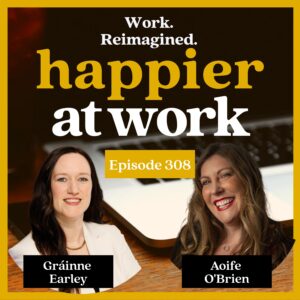
In this insightful episode of the Happier at Work podcast, Aoife O’Brien is joined by Gráinne Earley, Director of Employee Experience Solutions at FUEL, to dive deep into what employee experience truly means, from both a leadership and organisational perspective. Gráinne draws on her creative background in events and performing arts to illustrate how intentional touchpoints, big and small, shape workplace culture, drive engagement, and enhance retention. Together, they explore the critical role of leaders in moving beyond “just HR’s job,” offering practical advice for bringing joy, recognition, and genuine care to every stage of the employee life cycle.
In This Episode, You’ll Discover:
- Why employee experience goes far beyond HR initiatives, it’s every single touchpoint from day one to the final goodbye
- How first impressions (both at onboarding and in everyday office moments) can make or break long-term engagement and retention
- Why creating a great employee experience is a whole-organisation effort, not something you can hand off to HR alone
- The role of meaningful recognition and celebration in keeping employees engaged well after the honeymoon period fades
Related Topics Covered:
Role Models at Work, Artificial Intelligence, Human Connection
Connect with Aoife O’Brien | Host of Happier at Work®:
Connect with Gráinne Earley | Employee Experience Director at FUEL:
Related Episodes You’ll Love:
Episode 262: Foster Connection using Compassionate Leadership with Jen Marr
Episode 260: How to Make Work Meaningful with Zach Mercurio
About Happier at Work®
Happier at Work® is the podcast for business leaders who want to create meaningful, human-centric workplaces. Hosted by Aoife O’Brien, the show explores leadership, career clarity, imposter syndrome, workplace culture, and employee engagement — helping you and your team thrive.
If you enjoy podcasts like WorkLife with Adam Grant, The Happiness Lab, or Squiggly Careers, you’ll love Happier at Work®.
Join Aoife O’Brien for weekly insights on leadership, workplace culture, career clarity, imposter syndrome, and creating work that works for you.
Editing by Amanda Fitzgerald.
Website: https://happieratwork.ie LinkedIn: https://www.linkedin.com/in/aoifemobrien/ YouTube: https://www.youtube.com/@HappierAtWorkHQ
Mentioned in this episode:
Thriving Talent book – out now
Aoife O’Brien [00:00:01]:
As a leader, how do you create the moments that matter for how your employees experience their day to day work? That question is going to be answered on today’s episode of the Happier at Work podcast. I’m your host, Aoife o’, Brien, and my guest today is Granja early from Fuel hq. We talk all things employee experience, especially from a leader’s perspective, talking about buy in, why it’s important, and how to really shape the moments that matter. I know you’re going to really enjoy today’s episode. If you want to get involved in the conversation, you can drop me an email@podcastappieratwork ie or get involved in the conversation over on LinkedIn. Granny, you’re so welcome to the Happier at Work podcast. I know this has kind of been in the works for a while and I really enjoy our conversations every time we get together. So consider this like just other people eavesdropping on one of our normal conversations.
Gráinne Earley [00:00:54]:
Love it.
Aoife O’Brien [00:00:55]:
Do you want to let people know a little bit about who you are, your background, and what got you into doing what you’re doing today?
Gráinne Earley [00:01:01]:
Yes, absolutely. So I’m Granja Early. I’m the director of Employee Experience Solutions at Fuel. So Fuel are an events agency. We are a really creative agency. We work in the content world, in festival world, in brand world, and then also in the employee experience space. So I suppose I got into it through the events world really. But I suppose my background was always very creative.
Gráinne Earley [00:01:24]:
I was a performing arts student. That’s what I did as my degree. You know, I started a drama school. I loved creating moments for people and I loved creating those little bits of magic. So then when I got into the events world, it very much kind of translated and I was able to create those moments of magic for the customers and for the clients, whether it was a brand piece or whether it was a conference. And then I suppose through Covid, really when people were working from home and then people were going back into the office afterwards, I really started looking at the employee experience space and what that meant to employees, whether it was working from home and what experience did they have in the workplace or then going back to work or hybrid working. And really that’s, I suppose where my passion grew was how do we create those small moments of magic for employees in the workplace? And, and yeah, then FUEL just kind of became a great promoter of, you know, these amazing moments that you can have for your employees. And we started work with, working with our clients all across the world to, to create these moments and to great, create great Employee experience strategies.
Aoife O’Brien [00:02:29]:
I think it’s like for the purposes of listeners, maybe we take a step back and go, well, what actually is employee experience? Because if I’m thinking of myself coming from the corporate world as a leader in corporate, no HR experience, maybe expecting that that’s HR’s job or that’s not something that I really need to pay attention to or care about. Can you explain a little bit more about what employee experience is and then we can maybe talk about the leader’s role in, in creating those kinds of moments?
Gráinne Earley [00:03:00]:
Yeah, of course. And it’s a common thing that, you know, there were so many words that employee was used for employee experience. Initially it was employee engagement, it was comms, it was parties, it was, you know, a HOR activation. It was all of these different things. It was inclusivity, it was diversity, it was wellness. So there’s a huge amount of things that kind of fall in under that banner. And really employee experiences encompassing everything. But from a day to day level for the employee, it’s every touch point that they experience.
Gráinne Earley [00:03:30]:
So it can be something small, like the nice way that they get welcomed into the office or there’s something new there that’s exciting or a nice touch point for them or you know, how they are recognized as an employee or rewarded for their, the part they play in a company. Or it can then be the fun stuff, it can be the parties, it can be, you know, team building activities, it can be wellness. But really it’s about every touch point on their life cycle. So when they have started in that company to when they leave that company, every element that they kind of touch throughout that journey, really the life cycle of their, their journey in that, that company. That’s what employee experience is. It really encompasses everything. Anything that is going to create an experience for me, make me happier in work, make me feel like I belong and I’m part of something. That’s really what it is.
Gráinne Earley [00:04:19]:
And I think it initially kind of suddenly became hor’s thing. You know, people were like, oh, that’s a hor problem. That’s you know, hor looking employee experience. Yeah.
Aoife O’Brien [00:04:28]:
As well. You know, anything people related, that’s a hor problem. Yeah, you know, that’s, that’s their responsibility. Yeah, yeah.
Gráinne Earley [00:04:37]:
And it, but it became so much bigger than, you know, initially maybe. Yes, it probably was looking at people and culture and how that works in a company, but it became such a bigger beast of a thing when you start looking at all the different touch points. It can’ just be a hor Problem, as they say, you know, it can’t just be a well being committee that solves this or it can’t be, you know, employee resource group that resolves it. It needs to have the buy in of a whole company. It needs leadership buy in, it needs HR buy in. It needs management buy in. It needs everyone to have a part to play and to really be bought into this idea that we want our employees to be happy and that we have a great strategy in order to let them have a great experience.
Aoife O’Brien [00:05:18]:
So something that kind of struck me as you were talking is this idea of when you’re welcomed into the office. And I’ve been in different organizations that I worked in, but also visiting and having those different experiences of reception like that. I think it is kind of a crucial role. It needs to be very welcoming. But I have been on the receiving end of places where you’re like, this doesn’t feel welcoming, this doesn’t, you know, the person’s kind of rude or you just feel like, I don’t want to be here because the receptionist is in a bad mood. Like that can really impact on how you feel about your day or the place you work.
Gráinne Earley [00:05:53]:
And it’s the first impression, right? And it’s the same way if you’re hired into a company and it’s your first day or it’s your onboarding and if that’s a really poor experience, your first impression is extremely hard to come back from. So. And there’s so many statistics out there of, you know, if the onboarding process is poor, the longevity of someone working in that company is immediately diminished, you know, so that first impression is so important. So if that moment you step into the office is unpleasant or underwhelming and you’re kind of feeling, oh God, I don’t want to be in here today. And nobody is excited to be here and nobody has said hello to me and there’s no nice touch points. It doesn’t start the day off in a good way. In the same way, if you’re on boarding into a new company and that’s a poor experience and you think, God, they’re just rushing through this training and they don’t really care about me and I’m just a number and no one has actually asked me how I feel or has checked in to see, you know, what my experience is, then straight away you’re disengaged in that company or thinking, oh, now I have to go in here, I have to go through this process. Instead of thinking, this is so exciting, I’M being onboarded.
Gráinne Earley [00:06:56]:
I’m excited to see what this adventure brings.
Aoife O’Brien [00:06:58]:
Yeah.
Gráinne Earley [00:06:59]:
You know, and that’s what you want for your employees to feel. Obviously we’re not going to feel that every single day. We all have bad moods or bad days and things happening, you know, in our own lives. But as much as possible, you want people to feel engaged and excited and, you know, just happy and comfortable.
Aoife O’Brien [00:07:16]:
I think starting in a new organization, people at the very least should be feeling excited. Like you may have an opinion on that kind of that. The excitement gets beaten out of us over time when we get worn down by the culture of the organization or we experience, you know, after the honeymoon period, things start to quieten down or we get more overloaded with work and we see what’s really going on behind the scenes or we understand a little bit more about the politics and, or the relationships that people have with each other. I’m just thinking, you know, from my own personal experience, but for the very start, at the very least, I think we should want people to feel excited about getting started and, you know, into their new role.
Gráinne Earley [00:07:58]:
Absolutely. And like you say, when the honeymoon period ends, I feel like that’s also an extremely important part for employee experience to be playing. So it should be, as I mentioned, through the whole life cycle and at every touch point. So when you’ve hit that year mark, is there a bit of a celebration? Is there a bit of a kudos from your manager? You’ve, you’ve hit the year mark or you’ve passed your six month probation or, you know, you’ve managed to achieve 200 sales or you’ve, you know, what are these moments that are kind of hitting you throughout and are they being recognized? Are they being rewarded? Sometimes, obviously it’s great. Sometimes that’s not possible for financial rewards and things. But is it being recognized? Is your name up on a board to say, you know, happy anniversary or to say, you know, she has just achieved this, well done or a little mail gone round or a newsletter or something, you know, so when that honeymoon period does end, because it inevitably will always end, that there’s those other things to bring you back into that place of, oh, I do love working here.
Aoife O’Brien [00:08:55]:
Oh, wow.
Gráinne Earley [00:08:55]:
I do feel really recognized. Oh, they do really reward me and, you know, they really make me feel good. Even though I’ve had a really tough few weeks, I really feel good now at the end of that because of a manager or a leader or, you know, something.
Aoife O’Brien [00:09:08]:
Yeah, you’ve, you’ve reminded me now, Grania, of Some research I did as part of my masters that showed that it takes around. I can’t, I’m trying to think of the words to explain this, but basically it’s three. Three years is kind of the time it takes to really get your teeth stuck into an organization or a role. And there was quite a significant drop off then after that three year mark where people are like, they either stay for the long haul or they leave. And so this three years I thought was really interesting and important because I think we tend to focus on maybe the first few months, maybe at a stretch, the first six months at a bigger stretch, you might say nine months to a year that we were trying to onboard people. But if we think we need to actually do this for at least three years until they get to the stage where they feel loyal and committed to the organization after a three year period.
Gráinne Earley [00:10:06]:
Yeah.
Aoife O’Brien [00:10:06]:
That’s the amount of effort that we need to actually put in to creating the experiences that people want to have at work.
Gráinne Earley [00:10:14]:
Yeah, yeah, exactly. And even at that three year stage, like the three year itch I think they call it, isn’t it? It’s like you start looking, you start thinking, you know, you’ve settled in, you’ve embedded yourself and you’re wondering, is this for me or not?
Aoife O’Brien [00:10:25]:
This is a decent stint on my cv, on my resume, so it won’t look like I’m just going from job to job. I’ve done this for three years now and I don’t see anything changing. I’m not happy and I want out.
Gráinne Earley [00:10:38]:
Yeah. And a lot of companies will actually put that effort in, in between the three and five year period. Even, even if it’s a reward of when you hit five years, you get an extra two weeks annual leave or you know that there’s suddenly a new progression track from the three to five year period of here’s the next two years of what we want to commit to you and what you know, we hope to get in return so that it’s giving you something even extra. So for those first three years, maybe it’s a bit of recognition, maybe there’s some perks, some holiday parties, things like that that are going to keep you going and engage you. But then suddenly it becomes, oh, the same Christmas party, ugh, the same voucher. You know, we’re all so complacent and we all get fed up so quickly and you stop appreciating all the things that you loved when you first started somewhere and it’s very hard for companies to keep up with that. Because the cohort of employees is changing all the time. So you have some that are absolutely engaged in all these things and others that have been here five or six fed up with them, and they’ve forgotten that they’re even perks and they’re looking for something new.
Gráinne Earley [00:11:37]:
And maybe it’s a progression plan for them, or maybe it’s, I want the extra leave, or maybe it’s, you know, something else. So when you’re looking at a whole strategy, you’re trying to fit pieces for every type of employee, every cohort. So it’s a difficult thing to do. And it’s. I think that’s why it’s ever evolving. And this space, you know, there people always say, what’s the solution? Like, what is. And it’s like, there is no one solution. I wish, God, if I had that, I’d be getting, you know, paid a lot and I’d be on all sorts.
Gráinne Earley [00:12:09]:
But there is no solution. It’s like there’s just loads of different things that you can put in and there’s no one size fits all. You just have to put the effort in and make sure that you are prioritizing it and what works for you won’t work for another company. But if you find a solution that works for you now, great. And then start to evolve on that further and see, okay, that’s not going to work forever. What’s our next evolution of this, you know, experience?
Aoife O’Brien [00:12:34]:
My next question, just based on what you were talking about there was, does this stuff actually work? Like the rewards and the, you know, extra money or extra leave, like you kind of have answered it there, where it’s different depending on different people. It’s going to be different depending on different companies and even within the same company. We sort of need to evolve it over time so it doesn’t get too stale and expected like that has now become the expectation, even though what once started as a park. I’m kind of also thinking back to this is looking at a kind of a company level, at a leader level and the kinds of things that you’re talking about. I do address that in the thriving talent book. So I talk about things like understanding people’s needs and being able to satisfy needs on an individual basis. Like there’s no two ways about that. You have to as a leader understand the individual needs that an, that a person has rather than trying to find this one size fits all to match absolutely everyone.
Gráinne Earley [00:13:39]:
Yeah, yeah. And it’s true, like the, the one size fits all. They’re the. That’s the baseline, you know, like. And you are going to capture 60 or 70 of people with some of those things. But like you say it needs to be looked at at an individual level now. And that’s I, and I know that that’s extremely hard for leaders. Like how, how are they meant to get their jobs done when they’re also thinking of this? And I, I get that a lot from leaders.
Gráinne Earley [00:14:04]:
They’re like, there’s so much to try and think about and we’re trying and we did this. But actually this is what the employee wanted. And you know, they’re really struggling with the, the effort that needs to be put into it. And so I totally understand that. But the, the expectation now on individuals is that things are tailored to them and that they are heard as an individual and they don’t want to be seen as a cohort of employees anymore. They want the leader to have acknow them as an individual. They want them to know, especially after Covid, we all know way more about each other’s lives and that has continued. They want, you know, they feel the leader should know that this is my preference or that I will turn up to this, but I won’t turn up to this because.
Gráinne Earley [00:14:44]:
And that I have to pick up my kids at this time. So why did he put a meeting in at 5pm when he knows I leave at 5:15 and you know, and my lunch break is important to me. I take a full hour because I need to go for my walk with the dog or whatever it is. And leaders are expected now to understand all of that and manage it all amongst actually running a business and actually running a team or a function. And it is difficult. But I think the main thing is that you open yourself up to it and you are open and honest with the employees. And like I’ve often been in a situation where I’ve gone, oh my God, I know. You’ve told me that three times.
Gráinne Earley [00:15:19]:
I am so sorry, I have forgotten. And I’m putting a meeting into your diary. You told me that. I didn’t mean to dismiss it. I was thinking of next week. And you just acknowledge it and make sure they feel heard that there isn’t some sort of disgruntling in the background where it’s like, oh my God, that person always does this to me on a Tuesday or always, you know, and you just have to be open to the feedback you get from your team, from, you know, and, and try your best. And that’s all leaders can really be expected to do is. Is try Their best.
Gráinne Earley [00:15:47]:
And it is a two way street as well. You know, the leaders need to have buy in to the fact that this is an extremely important thing. And the employees need to have buy into the fact that, okay, these companies are trying really hard. And yes, some things are landing and some people are. Some things aren’t for me, but maybe it’s land somebody else and, you know, we both have to have understanding for each other.
Aoife O’Brien [00:16:07]:
Something that you said earlier, Granja, was this idea of care. Do I feel cared for? Now, that’s something that has come up on the podcast a few times. I’ll put pop links below for anyone who’s listening to those previous episodes. But one of them, two of them that really stand out. One was with Jen Meyer, who talks specifically about caring. And then the other one was with Zach Mercurio. It was his second time to join me on the podcast. But he talks about this concept of mattering and feeling like we matter at work.
Aoife O’Brien [00:16:37]:
And it sounds like what. Everything that you’re talking about relates back to that.
Gráinne Earley [00:16:41]:
Yeah, yeah. And 100%. And that is, it’s feeling like I matter, I am seen and they care, you know, so it’s. I am not the sea of the employees. Instead, they know who I am as an individual. They see me as an individual. They care that I am happy or not in this workplace. And they, they see that and empathize with whatever it is that’s, you know, going on in my workday.
Gráinne Earley [00:17:07]:
And that is a huge part of it now that we all want to feel that cared for feeling. And we want to feel that individuality in the workplace. And it’s not something that ever had like in previous generations. It wasn’t something that was expected. It was nearly, you know, we were nearly in a generation of, oh, wow, if I got time with the boss, this is a huge, big deal. And we used to, you know, all think, oh, my God, I’ve got 10 minutes to, like, make an impression with the boss. Now it’s nearly like, if the boss hasn’t acknowledged me by name, how dare he? You know, like, there’s. There’s a totally different attitude.
Gráinne Earley [00:17:39]:
Yeah. And I’m not. Yeah, exactly. And I’m not saying either is right or wrong, but we have to, like, look at the fact that that is what the generation wants now and they want to be seen as who they are. And they don’t want this wall up where it’s us and them. And if you acknowledge that and work on that, then you have a much more open work environment. For everybody.
Aoife O’Brien [00:18:02]:
You know, I saw something. Now this is years ago, years ago. And it was about this idea of individualization and how if you remember back again, this is coming back. This must be a long time, 20, 25 years ago. But Coca Cola put people’s names on bottles. I’m sure they did it globally, but they had the local thing to it as well. Because my name was on a bottle. My name is uniquely Irish.
Aoife O’Brien [00:18:26]:
Your name is uniquely Irish and I’m sure they had your name on a bottle as well. So like that’s the kind of one side of personalization. Other example that was shared was Google Maps where you, you know, I don’t know, are you old enough? I’m certainly old enough to remember when you had to use an actual map or an atlas to find your way around. If you’re in a.
Gráinne Earley [00:18:47]:
Just as useless as trying to navigate things back then as I am now, thank God for Google Maps.
Aoife O’Brien [00:18:53]:
But now, but now we have Google Maps and everything is personalized to us. Yeah, it knows where you are and it tells you where to go. And I think, think, you know, if, if we apply that to the work situation, we expect things to be personalized for us. We expect a personalized career path almost. And I think people have, I was going to say they’ve forgotten how to navigate their career. I don’t think people were ever taught how to navigate their career in a very strategic way. But also, you know, we’re kind of expecting the entire work experience to be personalized to us. We based on how the rest of the world has gone, you know, the, the individualization of everything.
Gráinne Earley [00:19:32]:
Yeah. And the thing that jumps out to me the most, not even just the individualization, which I absolutely 100 agree with, that is something that people are looking for, but they’re also looking for it to be instant.
Aoife O’Brien [00:19:42]:
And that’s instant gratification.
Gráinne Earley [00:19:44]:
Instant gratification, instant reward, instant, you know, but. And I don’t think a lot of companies or established companies at least, you know, that aren’t as fast paced, paced and maybe moving as some of the new startups, but I don’t think they’ve caught up with that quite yet. So yes, they may be looking at the individualization and trying to make sure that they are looking at employees as individuals now instead of a full cohort, but they’re not quick enough for the employees. So the employees are getting bored or fed up or being like, I brought that up two weeks ago and that hasn’t been rectified. God knows what else is going on in the company that is trying to be resolved and that has maybe been put on the back burner or it’s just they don’t know how to tackle it and suddenly it becomes, oh, they didn’t care and no one has got back to me and this. And then you have suddenly a really negative experience because you’re not at the same pace that the employee is. And suddenly the employee experience feels negative
Aoife O’Brien [00:20:39]:
and feels like interesting.
Gráinne Earley [00:20:41]:
So I find that’s the big battle at the moment. Yeah, I think at the moment the speed is the thing that companies are really suffering with. And sometimes, especially in the employee experience space, people want to get it all right at once and they’re like, let’s do a whole strategy and let’s fix everything. And that’s great if you have the time to do it, but the employees aren’t going to wait around for that. So really sometimes you’re better off just actioning one thing quickly or you know, addressing something when it happens or jumping on the celebration of something on the day instead of thinking let’s put two weeks of planning into this thing and then they’ve forgotten about it by the time they got there. So I think that instant piece is the new shift. The individuality I think has. It probably kind of came in last year that it was very big focus for a lot of companies.
Gráinne Earley [00:21:25]:
They were shifting from looking at everyone as a sea of employees to suddenly looking at the individual. But I think this year’s trend is going to be, it has to be instant as well. And trying to see how you can bring that in to employee experience in a really quick way.
Aoife O’Brien [00:21:38]:
Yeah, so I mean it’s the solution to that, to acknowledge what someone has said and to let them know that you’re looking into it. And this is typically the amount of time that it’s going to take. It’s not an instant process. It’s been added to a long list, it’s been prioritized according to the severity, etc, etc.
Gráinne Earley [00:21:54]:
So that’s communication.
Aoife O’Brien [00:21:55]:
Yeah, just letting people know that this you are being listened to. We are taking this on board, we are doing something about it. Can we come back to this idea then of like the grand plans that are going to require weeks of planning versus just the everyday things that employees experience. Have you got any examples or any tips that leaders can just start doing straight away to create a better experience for employees?
Gráinne Earley [00:22:23]:
Yeah, I suppose when we look at it, we try and look in three different areas. We look at shaping reputation being one thing. So maybe it’s that The EVP needs to be looked at or the employer brand needs to be looked at. And that’s kind of one section. And then you’ve got crafting culture, which could be an issue in some companies, which is all about looking at the diversity and the inclusion and the, the management and the leadership and what is the actual culture in the company. And then you’ve got creating experiences, which is kind of the third piece, which is the fun stuff and the, you know, the parties and the conferences and the all hands and the moments when we’re together and those big experiences. So I would say if a company is trying to look at where to start, I would look at those three bubbles first and kind of say, okay, where are the issues? Do we think it’s in, you know, the reputation piece, Is it the culture or is it the experiences? Because a lot of companies will have one or two of those things, right? And they just maybe haven’t got it all synchronized together yet. And so then when you kind of delve into that, you can probably find, okay, here’s one or two things that we could fix straight away.
Gráinne Earley [00:23:27]:
You know, maybe it is, we have not communicated properly about our evp. We know it as management and, but we haven’t communicated it out. So let’s quickly jump on that, let’s communicate this and say we’re really proud of what we stand for in terms of our employee value proposition. Or it might be, wow, our diversity and inclusion piece. We’ve really let that slide. We haven’t been looking at that properly, we haven’t addressed it. There’s, you know, some issues there in the company that we need to really jump on there and then jump on that quickly. So I suppose just identify where are the pieces that you feel the company is falling down and instead of trying to address it all at once, try find two or three quick wins which will show to your employees that you are moving, you are progressing and you are trying.
Gráinne Earley [00:24:07]:
And then you can be looking at the bigger picture in the background as well.
Aoife O’Brien [00:24:10]:
Well, yeah, brilliant. And like say if I’m a leader of a team and I want to create a better day to day experience for my employees and given that there’s people working in like a hybrid environment, maybe we’re not always together, we’re not always in the office, any, any kind of quick wins that we can use as leaders to create that better day to day experience.
Gráinne Earley [00:24:36]:
Yeah, like really communication tools are the way to go. Like it’s just as a leader, like, I mean, I myself have a team where we work from home some days, we’re in the office other days and it’s really just trying to be tuned into. Has there been moments of engagement between myself and some of those team members? Or has someone been particularly quiet this week? Or we haven’t seen them in the office or we haven’t, you know, and it’s really just trying to tune into that and, and then communicate and make sure that you are reaching out or that you’re giving an acknowledgement or that you’re checking in. And I think that’s the part us all feeling connected is the main thing that everything is hinged on. So if you have someone that’s feeling disconnected from a team or a department, the first fix is to communicate and try connect, right, to come together straight away. And so if that’s not happening, whether it’s through a call or a slack message or whatever it is, then you’re all, you’re already kind of in a losing battle. So I would say like there’s plenty of times where I’ve said, oh God, haven’t seen you in a while, you know, do you want to jump on a quick zoom and we’ll have a cup of tea together? You know, sometimes and maybe there’s nothing going on or maybe that’s the moment that they tell you, oh my God, all this stuff is going on. In my personal life, I’m really struggling with something.
Gráinne Earley [00:25:47]:
I’m not happy, I need support or whatever it is. Or they might just say, oh God, no, I’m grand. I’ve been stuck into this project and it’s been going great and I’ve been working with a different team so I just haven’t really been in the office that much. And you know, but those 10 minute check ins or the quick slack message and you know, the communication is, it’s the way to just pull the team together again.
Aoife O’Brien [00:26:05]:
I love this idea of connection. I think it’s so important to feel that sense of connection at work. It is one of our primary needs, one of the needs that we all have and something I suppose that that comes up time. You know, I won’t say time and time again, but occasionally comes up on the podcast is the time pressure that people are under as leaders and how do we make that time for connection or to, to think about. I think we touched on it earlier this idea of on top of my day job, you mean I have to also think of all of these other gazillion things that need to do to create a better experience for my employees, like how do you think that realistically leaders can do that? How can they carve that time on a day to day basis?
Gráinne Earley [00:26:48]:
Yeah, it’s a great question because. And it’s something I struggle with. Plenty of the clients I work with struggle with. And the one thing I would say because it’s, it’s a juggling act, right? And life is a juggling act. And this is now suddenly a new thing that has to be added. It’s another ball in the air that we have to juggle. So how we fit it in I suppose is one thing. And it’s going to be different for everyone.
Gráinne Earley [00:27:11]:
I suppose just prioritizing is, is the main thing. But what I would say more than that is if you are going to fit it in, do it with intention and be fully present. Because I feel like that’s where I see a lot of people fall down is they go, oh well, I fit that 15 minute meeting in. And then person who they met with and they say, yeah, but they glanced at their phone five times or you know, I could tell they wanted to rush me out the door so they think they’ve ticked that box or, or the emails popping up on the watch, that to me is, is a new one that I feel is more. Because people will intentionally put their phone away to try and be present. But the watch buzzes and you can just see the flick of the wrist, you know, and someone’s. And suddenly you’re like, they’re not engaged with this conversation. Let’s just wrap it up, you know.
Gráinne Earley [00:27:51]:
So how to fit it in is definitely a struggle. But I would say when you fit it in, make sure it’s an intentional conversation. And if you can only fit in 15, 15 minutes, that’s perfectly fine. People don’t need an hour therapy session. That is not what you’re there for. You know it’s not, that’s not the purpose of it, but it’s to just say, look, I really want to check in. We haven’t had a chat in ages. I, I’m absolutely slammed today, but I have 15 minutes.
Gráinne Earley [00:28:14]:
Do you want to meet me at the water cooler or do you want to quickly pop out for a quick walk around the block for 15 minutes and then I’ll get back and you’ve framed it already know you’re in a hurry, but they know that they’ve prior you’ve prioritized them and that you know you have 15 minutes of their time and that it’s face to face time. So I think again, clear communication and making sure you are present for those 15 minutes is much better than slotting an hour in and being disengaged for, you know, for half of that time.
Aoife O’Brien [00:28:41]:
Yeah. Wishing you weren’t there. Wishing you were working on projects, being
Gráinne Earley [00:28:44]:
like, I can’t believe I have to fit this in.
Aoife O’Brien [00:28:46]:
Yeah, yeah, yeah, yeah. Maybe kind of tied in with this idea is the idea of, of buy in that you touched on earlier. So as a leader of a team, how do we buy in to the fact that we actually need to do this? But then also at an organizational level, how do we. I was going to say convince. Convince is maybe the wrong word, but how do we get that buy in at senior leader level so that these kinds of conversations, this connection, the creating a more positive work experience for employees is seen as something that is a requirement to do good business as opposed to something that’s kind of fluffy and, oh, it’s the first thing that gets caught if we don’t actually need to do.
Gráinne Earley [00:29:29]:
And it is.
Aoife O’Brien [00:29:30]:
Yeah.
Gráinne Earley [00:29:30]:
And it is the first thing that gets caught. And I’m seeing it all the time. And especially last year in January when everything happened with Trump and it was the first thing to go, everyone was like, okay, we don’t need this anymore. We don’t need diversity, we don’t need inclusion, we don’t need. And suddenly it was like, oh, my God, all of the things that your employees are, are, are feeling those touch points to. You’re just going to get rid of. And, and it’s heartbreaking to see that. But I think in terms of the leadership buy in, the big thing is that for the employees, they need to see that it is spoken about, prioritized and visualized in the same way that a really important company strategy would be.
Gráinne Earley [00:30:06]:
So when the CEO steps up there to talk about this is the next product that is launching or this is the next, you know, strategy for Q4 or whatever it is that you’re. That they’re taking the employee experience piece just as seriously and that they are showing that this is a part of it and that we want to have happy employees and we want to make sure, like, the statistics are there in terms of companies that have great employee experience and, and in terms of the retention, in terms of the amount of money that’s, you know, coming in from those employees, the amount of work that. An effort that they’re putting into their jobs. So the statistics are there, but it’s definitely a struggle because, you know, I’m preaching to the converted here, you know how important it is most hor Leaders know how important it is, the employees know how important it is. But if you can’t get the managers to show and the leaders to show that it’s important to them as well, then none of the junior team members are going to buy in because they’re going to go, well, I know my manager actually wants me to sit at my desk during this lunch. He doesn’t want me to go on the staff picnic or whatever because I know he’s not going, so he doesn’t want me to go. Or, you know, she mentioned to me before that she doesn’t think this wellness stuff should be done in work. So I’m not going to, you know, it’s those kind of little, little pieces.
Gráinne Earley [00:31:19]:
Pieces. Whereas if you hear, you know, when I see my boss head out to the gym and go, I’m going to go get a quick 30 minute session in, I’ll meet you when I get back to discuss that. I’m like deadly. He’s heading out for his 30 minute session where he’ll say, did you get fresh air today? Did you get out, get out there for a 50 minute walk? You know, and suddenly you realize, well, God, if, if our bosses are doing this and they know that that’s important for their own mental health and for their work life balance and everything, then they’re happy for me to do it, or they’re happy for me to miss traffic and come in 30 minutes late and leave 30 minutes afterwards or, you know, whatever it is. But if you’re not seeing the leaders doing that, I think it’s very hard to expect the employees to feel comfortable enough to be themselves and to engage in all that stuff as well.
Aoife O’Brien [00:32:01]:
So it’s kind of like a combination of permission and role modeling. So by them doing that, they’re giving you permission to do that as well. But they’re role modeling the kinds of behaviors that they expect of their employees by actually going and doing that. Looking after their health, getting out into nature, getting fresh air, all of those good things.
Gráinne Earley [00:32:22]:
Yeah. And I know it’s been said to me before and I’m conscious of it, like, you know that there’s been times where I’ll eat at my desk while I’m on the laptop, you know, I’m not taking a lunch break. And I know that it’s been said to me a couple of times of, oh God, you know, are you not managing to get a break? And I’m so conscious now that I’m there. Look, there is times where I’m like, I’ll hide upstairs and I just have to try and get through the day and, but I’ll try and make sure that at least one or two days a week I’m very present in the office floor, having a lunch break, sitting with one of the dogs on the couch, having a little cuddle, taking 10 minutes and having a chat with someone and making sure it’s very obvious that okay, yes, there’s some days you have to work through and you have to play through, but I also do take my breaks when I need to. You know, if I’ve had a very stressful phone call, I might sit on the floor with one of the dogs for a while and go, right, this is my five minutes of therapy before I have to jump on another call and let people see this is all acceptable. You know, it’s just about finding what’s right for you. Really.
Aoife O’Brien [00:33:17]:
Yeah. Love it.
Gráinne Earley [00:33:18]:
The big things for me that I was, that I’m seeing this year and, and coming into 2026 is that individuality piece and now the instant piece. So I think that was an interesting piece to, to talk through because last year was all about the individuality, but I think that instantaneous peace is going to be very, very big this year of how quickly things can, can move in companies. And I think we’ve all seen that the pace of things has picked up and has never slowed down since seems to be on this trajectory at the moment, which means work life is a lot speedier and the expectation from clients and things like that is a lot quicker as well. So why wouldn’t the expectation from our employees be the same? So I think it’s just something good for, for companies to keep in mind. But yeah, no, I think we’ve, we’ve touched on a lot of other great stuff.
Aoife O’Brien [00:34:05]:
Well, now that you’re bringing up the, the kind of, the speed of change, I think it’s interesting to think about AI and we can maybe think about this from a couple of different perspectives. So the perspective of how do we use AI to create a better employee experience because AI is there to support us in work, but also the demands that AI has placed on us from a work perspective and what kind of impact you’re seeing. So anything that you’re seeing out there, or maybe it hasn’t really impacted that much.
Gráinne Earley [00:34:36]:
Much. Yeah, I think it’s impacting on the day to day stuff and I think the fear around it I’m hoping has eased up a little bit. But I know in some companies it still is there that this fear of being Replaced and the fear of, you know, this ever changing thing and is my job going to be safe? And there’s a lot of anxiety around at the moment. So I think in companies, in terms of looking after your employees, it’s very important to have a clear AI policy and to have a clear understanding in the company. I know we can’t process promise, we can’t promise anything. None of our roles are promised. God knows what the robots are going to do next. You know, God knows what AI is going to develop into.
Gráinne Earley [00:35:11]:
But I think having that clear communication of here are the AI tools that are really going to help you in terms of your job. And we’re excited as a company for you to utilize these and take this pressure off your job. But nobody can replace the human interaction that you have with our clients and what you bring to the table and the creative brain that you have, have. And just making sure that employees know that there’s two sides of this. There’s the benefit of AI and also to be reassured that they are not being replaced. It’s meant to be a partnership, but it’s not a replacement. I think that’s the. The best approach to it, really, because we can all see the benefits.
Gráinne Earley [00:35:45]:
We can also all see plenty of negatives. And I certainly do, like, see, you know, all the recordings of calls and all of the transcribing and all that kind of stuff is fantastic. But also it can be a little bit dangerous and a little bit worrying. And you’re seeing people, people kind of being afraid to say things in meetings now because it’s all being recorded or it’s all being transcribed and someone can get that transcription sent to them. So I think we’re going to start to see a little bit of a shift there as well. And I really hope that AI doesn’t remove a bit more of that psychological safety that people had felt.
Aoife O’Brien [00:36:21]:
Yeah.
Gráinne Earley [00:36:21]:
So that’s a part that I would be a little bit concerned about. I haven’t seen it massively yet, but I know that there’s been a couple
Aoife O’Brien [00:36:27]:
of occasions because things are being recorded.
Gráinne Earley [00:36:29]:
Everything’s being recorded.
Aoife O’Brien [00:36:30]:
Yeah, it’s kind of. It’s all fair game now. And people.
Gráinne Earley [00:36:33]:
Exactly.
Aoife O’Brien [00:36:34]:
Access to information, people can access what you’ve talked about and. Yeah, yeah, yeah.
Gráinne Earley [00:36:41]:
And I think even with the whole transcription piece, it can be very much. Aoife said this, then Granja replied with this, then Aoife sounded angry and said this, then Grania sounded defensive and said this. You know, the. It’s because people tend to not watch. Yeah, it’s the interpretation of. And I think that’s where people are starting to be a little bit more wary. And I have noticed myself in some meetings, you know, that if it’s something where someone goes, I’m just going to click record or, don’t worry, Gemini is taking the notes for me or whatever, you can see that people are a little bit. A little bit quieter.
Gráinne Earley [00:37:14]:
And then when it’s all closed and done and we might be stepping out of the meeting, someone will say, could I just grab you. Could you stay back for five minutes? And then that’s when they want to tell me what they actually wanted to say. And I’m like, oh, does this mean then we’re suddenly going to start having really inauthentic conversations in the meeting zone and the real conversations are going to happen outside of that? I’m not quite sure yet. I don’t know. But it’s definitely something that’s been on my mind on the indie AI space.
Aoife O’Brien [00:37:41]:
Yeah.
Gráinne Earley [00:37:42]:
Yeah.
Aoife O’Brien [00:37:42]:
Watch, for sure. Yeah. Gráinne, the question I ask everyone who comes on the podcast, what does being happier at work mean to you?
Gráinne Earley [00:37:49]:
It’s a good question, honestly, for me, and it’s my motto in life. It’s balance. My niece says Medium is her favorite. This was something she said when she was about 3. She’s about 8 now, but we always go back to her saying, medium is my favorite. It was. I can’t even remember what it was about. But we always joke about, like, you know, yeah, Medium is great, isn’t it? Balance is great.
Gráinne Earley [00:38:12]:
Like, you don’t have to be all out on everything. You don’t have to be the worst at everything. Like, Medium is a lovely place to be. So, like, since she was 3, I’ve always repeated it back to her. And, like, I always just think, yeah, no, medium speed in the car and medium, you know, pace of this. So for me, it’s. It’s balance. It’s.
Gráinne Earley [00:38:29]:
It’s, you know, having that balance in the workplace. And I think the connection piece that we talked about earlier is extremely important. But the other two pieces that I think are very important as well. Like, for me personally, yes, I want the connection, but I also want clarity, and I think that’s something that people struggle with as well in their roles. When you have clarity and you have. And you have a clear understanding of your role, of your position in the company, you feel a lot more yourself and able to kind of relax into your role. So, like, having a good connection with your colleagues, having clarity and then also growth, like for me, I really want growth and I always want to feel like I’m challenging myself or have something new to look forward to, something exciting and that the company is growing and I’m growing. So I think.
Gráinne Earley [00:39:11]:
And maybe that’s what balance really is, is having all of that together. But I think for me, it’s connection, clarity and growth and just finding that balance to feel comfortable in my skin, in the workplace, amongst all the other hurdles that are thrown at us.
Aoife O’Brien [00:39:24]:
This is it, isn’t it? If people want to connect with you, if they want to find out more about the work that you do at fuel, what’s the best way they can do that?
Gráinne Earley [00:39:33]:
Yeah, the website is fuelhq. Ie, so it’s probably the first place to go. Or pop me an email. Groanfuelhq.ie. i’m always happy to chat and talk through what we do, so. So, yeah, reach out.
Aoife O’Brien [00:39:46]:
Brilliant. Love it. Thank you so much for your time. I really enjoyed this conversation. I think we did a bit of a whistle stop tour into employee experience, but also specifically for what leaders can do, so really enjoyed it. Thank you so much.
Gráinne Earley [00:39:57]:
Yeah, brilliant. Oh, thank you for having me, Aoife. That was great.
Aoife O’Brien [00:40:00]:
That was Gráinne early talking. All things employee experience. I’d love for you to get involved in the conversation. Don’t forget to leave a rating or review on your feedback favorite platform. Do reach out to me directly podcastappieratwork.ie. or get involved in the conversation over on LinkedIn.