Are you struggling to see the true value and impact of your work in today’s fast-paced environment?
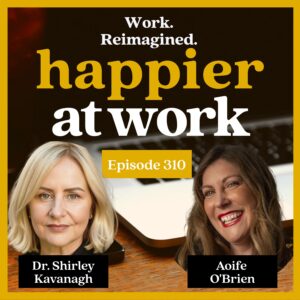
In this episode of the Happier at Work podcast, Aoife O’Brien welcomes Dr. Shirley Kavanagh for a deep dive into creating real value and impact at work. Together, they explore how to align daily activities with desired business outcomes, the importance of discipline and pausing for reflection, and why HR practices need to be connected to business strategy. Shirley shares her journey from financial services to executive coaching and organisational development, drawing on her PhD research into how people practices are actually implemented in organisations. The conversation highlights the challenges of keeping up with rapid change, especially with new technologies like AI, and emphasises practical ways individuals and leaders can prioritise what truly matters.
In This Episode, You’ll Discover:
- The frequent disconnect between people (HR) practices and the real needs of the business.
- Key findings from Shirley’s PhD research: the different ways line managers implement or adapt HR practices like appraisals, and why “translation” can add value.
- The necessity for HR professionals to deeply understand business drivers, KPIs, and strategy to earn credibility and influence at the decision-making table.
- How to articulate the impact and value of HR or other support functions, especially when seeking investment and support from leadership.
Related Topics Covered:
Human Connection, AI in the Workplace, Diversity at Work
Connect with Aoife O’Brien | Host of Happier at Work®:
Connect with Dr. Shirley Kavanagh | Executive Advisor, Shirley Kavanagh Consulting:
Resources & Episodes You’ll Love:
Episode 195: Workplace Culture Dynamics: Creating a Positive Work Environment with Caroline Collins
Episode 236: Navigating Uncertainty in Leadership with Maggie Jackson
Episode 228: Fostering Curiosity and Building Trust at Work with Julie Pham
About Happier at Work®
Happier at Work® is the podcast for business leaders who want to create meaningful, human-centric workplaces. Hosted by Aoife O’Brien, the show explores leadership, career clarity, imposter syndrome, workplace culture, and employee engagement — helping you and your team thrive.
If you enjoy podcasts like WorkLife with Adam Grant, The Happiness Lab, or Squiggly Careers, you’ll love Happier at Work®.
Join Aoife O’Brien for weekly insights on leadership, workplace culture, career clarity, imposter syndrome, and creating work that works for you.
Editing by Amanda Fitzgerald.
Website: https://happieratwork.ie LinkedIn: https://www.linkedin.com/in/aoifemobrien/ YouTube: https://www.youtube.com/@HappierAtWorkHQ
Mentioned in this episode:
Thriving Talent book – out now
Aoife O’Brien [00:00:09]:
If you’re feeling really busy at the moment, but you’re also wondering, well, what impact am I having, what value am I bringing to the work that I’m trying to do, then today’s episode is absolutely for you. This is the Happier at Work podcast. I’m Your host, Aoife O’ Brien and my guest today is Dr. Shirley Kavanagh and we’re gonna welcome unpack all things impact and value at work and how do we create better value and how do we link what we’re doing on a day to day basis with the outcomes that we’re trying to create. So I know you’re really, really going to enjoy today’s episode. Even if it’s a mindset shift that you take from this, I think you are really going to take a lot from it. I would love to know what you think of today’s conversation. So do get involved in the conversation.
Aoife O’Brien [00:00:54]:
You can drop a comment below where wherever you are listening or watching the podcast and get involved in the conversation over on LinkedIn. You can find me, I’m quite active there on LinkedIn and also feel free to reach out to me on podcast@happieratwork.ie and let me know what you thought. Shirley, welcome to the Happier at Work podcast. I’m really excited for this conversation and I know we’ve had a brief chat beforehand just to kind of see, suss out what we’re going to talk about. So I’m excited to kind of dive into what we’ve, we’ve decided we’re going to talk about today. But for listeners, do you want to let people know a little bit more about your background, what you’re doing now and why you care so much about this people stuff.
Dr. Shirley Kavanagh [00:01:39]:
Thanks very much, Aoife, and I’m delighted to be on your podcast, one of the most significant podcasts there is around. So thank you very much for inviting me. So great to have this conversation. Yeah, very happy to talk about my own background, which is probably a little bit varied. I done a number of different things. I started off in financial services, working at the business end, pricing business, all that sort of thing with AXA. And I stayed there for around about 12 years, worked really hard, had lots of opportunities, ended up being an executive director on the Irish senior team and then decided I was going to leave really because I think at that stage I was still relatively young from a career perspective and I just wanted to do so something different. So I remember my father saying to me, who worked for himself, he said, you know what, Shirley, it’s always really rewarding when you work for yourself.
Dr. Shirley Kavanagh [00:02:34]:
And he said, you’re the master of your own destiny. So without any grander plan than my late father’s advice, I decided, well, I’ll give that a go. And it was funny because at that stage now I’m talking sort of 90s, somebody had been talking to me about, oh, you’d be a great coach. And at that stage, it was a very new concept. Actually, nobody was really talking about coaching. Sort of very early, yeah. And I remember asking this guy, like, why do you think that is? Like. Like, what does a coach actually do? In fact, I didn’t really know very much.
Dr. Shirley Kavanagh [00:03:10]:
And he said, well, you’ve got lots of experience. You know, you could help people who maybe are starting off their careers in leadership, who are working in international organizations, who are going through change programs, because you’ve essentially done all of that yourself. And I said, okay, I. I think I’ll give that a go. Which I did. And it managed pretty well for me. So I stayed doing that for around about 10 years. And then my final significant corporate role came about.
Dr. Shirley Kavanagh [00:03:39]:
This is a story I tell. And somebody said to me, you shouldn’t really be telling that story, but I am going to tell it because it just shows you you never know when opportunity strikes. And I’d gone to see a senior airline executive at a business breakfast, and it was pretty full, full house. Everybody was really interested to hear what he had to say. And I went into the ladies restroom, and in there I met my next employer, actually, because I just got talking to this lovely lady and she said, what are you doing? And I said, well, actually, I’m working for myself at the moment, and this is what I do, and this is where I came from. And she said, why don’t you come out and have a chat with us? So, funnily enough, I thought I was going out to have a chat for a consulting gig, if I’m being perfectly honest. And I ended up, what turned out to be an interview with two fans. Fabulous people, actually.
Dr. Shirley Kavanagh [00:04:30]:
One was Emer Kenney, who was the global head of HR for UDG Healthcare. And the other was a super, super person that, subsequently the chief executive, Brendan McAtamney, who sadly passed away. And they were the two people who convinced me that absolutely I wanted to work in UDG Healthcare. And I stayed there for seven years, global head of OD and talent again. And at that stage I started doing a PhD also. But one of the things that always struck me was the disconnect between sometimes what HR people were Doing or in terms of their practices and policies for the organization and what the business actually needed. And that’s what fed my interest in my PhD in later life as well. And that was actually the topic of it.
Dr. Shirley Kavanagh [00:05:23]:
It was all about the implementation of people practices by line managers and just investigating what line managers actually do and think of some of the people practices that are implemented. So that was kind of really interesting. So that’s what I do now. I work with clients either in the executive coaching space, more predominantly in the team facilitation area, senior teams who are going through change and complexity and trying to figure out how we navigate through this world. And yeah, so that’s pretty much what my world looks like, which I’d love to say was part of a grand plan at the beginning. It wasn’t, but that’s where I ended up and I’m really happy about it.
Aoife O’Brien [00:06:07]:
Well, it’s Steve Jobs who says we can only connect the dots by looking back. I think it’s so hard to look forward, especially if you think how much disruption happens in the world of work and not being able, you know, not knowing that certain roles even exist or certain tasks even exist in the future because we just, we just can’t see that far ahead because things are changing so rapidly. But I’d love to, to come back to this idea of the kind of, the disconnect. I love how you describe that. The disconnect between HR and business practices, essentially, or, you know, business outcomes. Because I don’t come from a HR background. I, I’ve always been in commercial roles and the perception of all of the people stuff is that sits with HR and anything related to people. And even when I was having issues at work, I was like, why aren’t HR doing anything about this? You know, why, what’s happening, what’s going on? And the perception also that if you do have issues, and I’ve heard this directly from some colleagues as well, where if you do have an issue and you surface that issue with hr, they kind of tend to take the side of the business and that’s the perception within the business.
Aoife O’Brien [00:07:22]:
So then it’s like, well, why should we even raise this issue if they’re there to protect the, the HR people? So what I’d love to kind of dive into just a, kind of a brief, like, what were the outcomes from, from the, the PhD research? Like, it’s such an interesting area. And I, it’s so fraught, I think, because there is this perception.
Dr. Shirley Kavanagh [00:07:44]:
Yeah. And you know. Well, I mean, there were a Couple of things, really. I mean, there are some people. The research that I did with three organizations, and I had to take one people practice, actually, and the people practice. I told. I took, you know, the appraisal process because everybody does that. You know, it’s sort of easy to compare across organizations.
Dr. Shirley Kavanagh [00:08:04]:
And really there were three. Three groups of people, you know, there were. There were people who really championed it, you know, and said, yes, hr, you’ve really got it. I love it. We’re implementing it. We’re doing everything you need us to do. Fantastic. Almost accepting it as it was without any questioning of the process.
Dr. Shirley Kavanagh [00:08:23]:
Then you had people who were reluctant to. To employ the process at all. You know, they were really the contrarians as such, who, you know, didn’t engage with it, didn’t implement it. They’re. They’re the typical type of people who, when the CEO or the HR folks send out a list of this is what the performance is like of the completion of appraisals for across the business. These would be the people who were down at the end. You know, we’ve only done 10% because we’re way too busy and blah, blah, blah. But then I think the more interesting group where the group of people that were the translators, let’s call them.
Dr. Shirley Kavanagh [00:09:03]:
And I was really interested in these people because what these people would do would say, okay, hey, Jor, you’ve given us something that is for our business to use. We kind of get. It’s important across the organization, but it doesn’t really quite fit what we want to do and how we work within our business. So we’re going to tweak it a little bit to suit ourselves right now. I found that really interesting because the tweaking, it was not a bad thing to do. They were making it more relevant to their business. And in fact, in some of the cases I looked at, they were actually taking best practice from other organizations that they had come across. But they didn’t tell HR about this, which was really funny.
Dr. Shirley Kavanagh [00:09:43]:
So they might have added in another step to the process. You know, they might have. Some of them even changed their forms. All sorts of things were going on. And I think, gosh, this is really, really interesting. And I think, for one thing, it really reinforced to me, Aoife, that, you know, the right answer was not you have to adhere to the HR people practices as they are delivered to you. What was more important was, is it useful to the business? How does it work for the business? And I think one of the big things for me in terms of practical Implications around this was the need for HR folks to really engage with the business. When it comes to any people practices that are being implemented, they are not the people managers.
Dr. Shirley Kavanagh [00:10:29]:
Hr, you know, should be a strategic enabling function as such. The strategic part being very important because a lot of HR functions are not at the strategic discussion and that’s a terrible pity because that absolutely needs to happen. But understanding the dynamics of the business, the drivers of the business, the commercials of the business, the KPIs of the business. I was fortunate when I, when I told that story, you know, early on about being given hr, very reluctantly. I was lucky though, because I knew how the business worked.
Aoife O’Brien [00:11:05]:
Yes.
Dr. Shirley Kavanagh [00:11:06]:
And I knew what the discussion was at the top table around performance, business performance. So, you know, I always say to people, I do some lecturing on a master’s HR program and I say to them, look, one of the most important things you need to do is you need to understand what drives your business and you need to be able to talk about that and you need to be asking about the drivers of the business because it’s the only way you gain credibility.
Aoife O’Brien [00:11:36]:
Yeah.
Dr. Shirley Kavanagh [00:11:36]:
You know, you earn your place at the table.
Aoife O’Brien [00:11:38]:
Yeah, yeah, that. It’s, it’s so interesting that you say that because I think, because I come from this commercial background, I just take for granted that everyone understands that. But I think if you haven’t been, if you’ve been in some sort of a support function, if you’ve not been client facing, if you’ve not been out there with revenue targets, etc. Etc. Then maybe you, you don’t have visibility on that. And so you have a, let’s say you have a new program to roll out and you’re like this, this is a really popular program, this is what other companies are doing, but you haven’t actually related that back to the business outcomes that you’re trying to achieve within the business, then maybe it’s going to fall flat. So it’s, it’s interesting and it kind of ties in with what we said previously that we were going to talk about in relation to the impact and the business outcome. So how have you seen like, you know, have you seen any outcomes where this has changed or are you seeing a shift from hr? Like one of the biggest challenges I see is they can’t really explain the value of what it is that they do.
Aoife O’Brien [00:12:45]:
And so when it comes to talking to the board, the executive team to try and get investment in running programs, they’re at a loss because they can’t explain the return on Investment.
Dr. Shirley Kavanagh [00:12:59]:
And it’s a really good point. And you know, it can be really hard actually to do some of that in fact, you know, because some of the interventions could be long term interventions. So, you know, kind of there’s no immediate. And you know, now we’re finding more and more that the business case for something that has a three year return on it is just way too long actually. And from a HR group who are not being very explicit about why this is important and what the benefits are, that doesn’t help that either. So just to your point about impact though, and value, which is one of the most important things that you said there constantly, like any function, actually it’s not just for people, functions, HR functions, talent functions, whatever we want to call them. We all need to add value, you know, and we all need to understand what we’re doing. Does it actually add value? And then the next question is, value to whom? Yeah, you know, and it’s really being thoughtful about that before we do anything.
Dr. Shirley Kavanagh [00:14:07]:
And you know, I think sometimes we lose sight of some of those really important rigors about just saying, okay, let’s step back. What are we actually trying, trying to do here? Yeah, you know, what are we actually generating here? Why is this actually important? Because people get caught up in the argument and the excitement of things and whether it’s new technology, whatever it is. But some of those really important disciplines that were probably drilled into people many, many years ago, you know, in terms of best management practice, some of those we need to kind of unearth again. And you know, I’m sure you’ve sat in meetings, I’m sure there’s many people who’s listening to this who sat in meetings at senior levels or middle management levels or whatever. And meetings, of course are a huge drain on time if they’re not productive. And it just starts losing track. And you’re sitting there saying, well, hang on a second, where are we going with this? What were we actually trying to do with this? And the most important thing anyone can do there is just saying, can we just stop for a moment? Can we just go back to why we’re having this discussion? What is it we’re actually trying to do? Where is the value in this idea? And I think that’s a really important rigor that people need to get back into the rhythm of management and leadership activity.
Aoife O’Brien [00:15:24]:
Actually, yeah, if I think, and you know, I’m gonna. I can think of this from a couple of different perspectives. The one being when I was in corporate and you’re caught up in the busy work, and your client asks you for something and you negotiate maybe a timeline for it and you deliver that and that’s it done. And we won’t even think about the Pygmalion effect where the time expands. So if they give you two weeks, then are you going to take two weeks and are you going to perfect it and all of that kind of stuff, rather than taking the two hours that it should have taken to actually do it? So thinking about all of those things and different people have different perceptions. I talk about this in thriving talent, like our different perceptions and relationships with time as well. In my own business, then I can be like, oh, and there’s an exciting shiny thing that I want to get involved in. And it’s, it’s hard to kind of rein that back in and say, right, fundamentally, where is the value here? What is the impact that I want to have? And how does that new idea that I have relate back to that? So it, I think it impacts us no matter what we’re doing, is getting carried away with the busyness, especially with AI.
Aoife O’Brien [00:16:34]:
And I get caught up in the hype, especially, you know, and I don’t. I haven’t obviously experienced AI as someone who’s working in corporate, but I have experienced it myself and, and among other entrepreneurs. And there’s like, there’s a new tool that does this. You definitely need to start using this. And you kind of feel like you’re being left behind in some way if you’re not using a specific tool for a specific thing. And so I don’t know, like, do you know more about what’s going on within organizations and how do we bring people back to asking those fundamental questions about what, where’s the value here? And I’ve spent X amount of hours producing something, but actually, what is the impact of what I’ve produced? And beyond that, how do I communicate that impact to other people?
Dr. Shirley Kavanagh [00:17:25]:
Yeah, and, you know, I think there’s something around discipline here, actually. Aoife, you know that in this environment, discipline is required. Discipline is required at the individual level and it’s required at the corporate level. And we’re probably not seeing enough around that. I mean, there is so much going on at the moment. One of the things that I, I did when I was just finishing up my PhD was I was a research fellow with Trinity College, and we were looking at advanced technologies. Now, that was about two years ago. We’re talking to organizations about this, these new technologies that were coming on board.
Dr. Shirley Kavanagh [00:17:56]:
You know, generative AI. How was it going to impact them. And at that stage there were an awful lot of unknowns. But I do remember very clear speaking with somebody within the industry who was part of the research group that we were looking into. And I remember him saying at that time to me, you know what, Shirley? We used to meet every week to talk about what was happening in the world around technology. We’d have a big leadership meeting about it. He said, we do it every 24 hours now. And I remember thinking, gosh, you know, like, that was a couple of years ago.
Dr. Shirley Kavanagh [00:18:32]:
And I was saying, this stuff is really moving at pace. And, you know, it’s how we keep ourselves disciplined to not waste time either and to, and to realize where, you know, there’s a lot of talk about the human and, you know, a lot of legislation coming down the road which is, which has been implemented and is absolutely needed. But this whole human AI piece, you know, how, how is the human going to interact? And I think there’s a few things, I think leaders need to be really curious and need to keep up to date, quite frank. It doesn’t mean you have to be the deep expert, but you do have to know some of the trends that are emerging. You know, you do need to know about agentic AI maybe being different to generative AI. You do need to know how that could impact your business. And you do need to be able to ask the head of IT or whatever that person might be called within your organization when they come up with some shiny, bright new idea. And you really need to push them and say, well, hang on a second, what is this actually going to do for our business? Who is going to be benefit? What is the value? What is the impact? Because I don’t know about you.
Dr. Shirley Kavanagh [00:19:44]:
I mean, I, I was working on some. I use AI, of course I use AI. I mean, yeah, who doesn’t? But anyway, I do remember earlier on this week thinking about this because there was a particular project I was working on for a client and I said, oh, this be easy. I can use AI and we can kind of get an answer fairly quickly. And I remember thinking, no, the nuance around that is all wrong. No, it’s not telling the story. No, that’s not right. And actually I probably put as much time into it afterwards because I knew in my own head, I knew the, the, the type of client it was.
Dr. Shirley Kavanagh [00:20:18]:
I knew really how they’d respond. So there’s some of the soft skills that, you know, AI can’t deal with that. So it’s, it can be. We have to be careful not to be naive, you know, we have to be careful not to trust something that doesn’t exist. It’s not an emotionally intelligent instrument. And I remember somebo, he’s saying to me, and I thought this was just a fabulous line. Just said, remember, AI doesn’t care. It doesn’t care about you.
Dr. Shirley Kavanagh [00:20:47]:
And I remember thinking, my God, my hopes now.
Aoife O’Brien [00:20:50]:
I thought, like, AI was my friend. I thought my chat GPT, the way it talks to you, it makes you feel that way.
Dr. Shirley Kavanagh [00:20:57]:
Absolutely.
Aoife O’Brien [00:20:57]:
Because of everything. It’s, you know, oh, ifa, that’s such a great idea. Oh my God, no one’s ever thought of that. And I’m like. And then I’ll challenge it back and be like, you’re, you’re so right. I’m like, wait a minute, you’re going against everything you just said a second ago and then now you’re blowing smoke up my ass.
Dr. Shirley Kavanagh [00:21:14]:
Yeah, but you know what, there are real risks in it because, you know, I, some of my time I spent with 17 year olds in schools, you know, talking about leadership because we really need people, you know, who will step up to leadership, you know, at a political level or, you know, social level, organizational level, all that sort of thing. So I’m very keen that, you know, we start really inculcating that in young people that they see despite, you know, sort of the, the challenges of being a leader in the world today. We need leaders. But I do remember giving them that line because there are teenagers who, who see AI as their friend and that’s where they’re getting their advice. And I, I had to be really clear and I think it doesn’t care about you. So be careful of how you use the information that’s given back to you. Just doesn’t care.
Aoife O’Brien [00:22:06]:
Yeah.
Dr. Shirley Kavanagh [00:22:07]:
So there’s a lot of things out of our control in that sense around AI, but the one thing we do have control of in organizations and as individuals is being curious, being aware, being aware of the limitations, being aware to your example that depending on how it’s set up, it might just validate ifa, that’s a fantastic idea. And then you’re saying, well, hang on a second, I’m not entirely sure it is. And you ask it back and say, well, yeah, it’s not a great idea, all of that sort of thing, you know, we have to be careful about the quality of our thinking in it. Absolutely. Yeah.
Aoife O’Brien [00:22:40]:
It’s interesting. Glean did some research recently. I’ll put a link down below in the show notes. But they, they came up with these Two terms which I think are really apt. And, and in a future episode of the podcast, I will be talking about this research specifically, but they call it bot sitting and bot shitting. So the bot sitting is, it’s so catchy and it’s so easy to remember, but the, the bot sitting is the, the amount of context that you have to feed into the AI to get the result that you’re, that you’re looking for. When the, the data, when the information comes out or when the response comes out, it’s how much time does it take to actually review it and correct it if required, or adjust the context so that it understands a bit more. So the promise of AI giving us all of this time back or, you know, making us so much more productive has not been quite realized just yet because of all of these reasons.
Aoife O’Brien [00:23:39]:
And I think it’s, it’s so interesting. We think, oh, I have AI, so now everything’s so much faster. But is it faster or are we having to spend a lot more time babysitting or bath sitting? Or is it that we think it’s so much faster so we take on additional work and we need to think again about that work. Is that the impact that I want to have, or what value is the work that I’m doing actually bringing to the organization? Do you have any thoughts on how to assess, how to really think about value? So whether you’re an individual thinking about this for yourself, yourself, or whether you’re a leader in this, like we said, really uncertain times with a huge pace of change and maybe priorities are changing all of the time. Any, any maybe questions or frameworks that people can think about?
Dr. Shirley Kavanagh [00:24:35]:
Yeah, I mean, I, I, I think there are some basic rigors. So if we sort of unpack that a little bit and we think of the individual and then we think of the, from the corporate lens as such, you know, as I said, for the individual, it does go back to discipline. You have, you really have to think, is this adding value? You know, what am I trying to do? And almost stepping back all the time. I’m a great believer now more than ever of the pause.
Aoife O’Brien [00:25:00]:
Yeah.
Dr. Shirley Kavanagh [00:25:00]:
You know, just taking the pause and saying, well, hang on a second, where, where is this going? You know, am I getting caught up in, you know, we were talking about vibe code coding and how, you know, before we got on this call, and I think I managed to build an app using Lovable, you know, and it was great fun. It only took a few minutes or whatever it is, but, you know, it was great fun. That’s probably what it was. So I think we have to kind of sort of unpack the things that are just curious and interesting and great fun to do with the things that added real value to what we’re trying to do. So I think it’s always going back that. That discipline of what. What am I actually trying to do here, you know, is really important.
Aoife O’Brien [00:25:40]:
So you’re saying about the pause, but for me, it’s like permission to pause as well, you know, to give ourselves that permission to say, I can take a step back here because I think, and I include myself in this. We get so caught up in what we’re doing that we think it’s so important that we can’t take that step back and look at the bigger picture. But I think it’s important to actually do that.
Dr. Shirley Kavanagh [00:26:01]:
Yeah. And you know what, Aoife? I understand in some healthcare environments that that pause is really important. You know, we’re in a trauma room where there’s so much going on and it’s chaotic, there’s a life at stake. That concept of pause also exists, and it may only be for seconds, but it’s just enough to break that chaos and say, well, hang on a second, just check in with everybody right back in again. And that has a big impact. And I think that permission to pause, as you talk about, is something that, yes, we need to give ourselves, whether it’s breaking away from a task. Let’s say that maybe where we’re using generatively and, you know, when you’re using Gen AI, you could keep at it. You know, you can keep doing it, and you can find yourself spending a lot of time on it.
Dr. Shirley Kavanagh [00:26:48]:
There’s a piece where it’s saying, another question.
Aoife O’Brien [00:26:49]:
I’m going to open it up.
Dr. Shirley Kavanagh [00:26:50]:
Exactly.
Aoife O’Brien [00:26:51]:
That was me just this morning. I’m like, I have this question. Straight AI.
Dr. Shirley Kavanagh [00:26:55]:
Yeah, absolutely. So I think the importance of not using our human connections as well. Before we started this call, we were having a chat and we started talking about things, and when we chatted before we started talking about things. So I think having those human chats are very important to ground us. And I think some of us have lost that, you know, importance of networking and just sharing information and sharing knowledge. Things like after Action reviews, for instance, in organizations where, you know, something has been implemented, figuring out how, how did it go? Did we actually achieve what we were supposed to achieve and what we. What have we learned for the future? That that whole important piece around growing those things are still as important in this world, if not more important, actually Particularly where you have shiny new technologies that can cost an awful lot of money and where money can be lost very easily without real rigor around the first point before we do something, but after we’ve done something as well and actually taking something around that. So some of those, you know, they may be, I don’t know, maybe they’re not used as much, but they’re really good disciplines in organizations, you know, to really stop and say, okay, what have we learned from that? What went well and being honest and truthful about that didn’t go as planned.
Dr. Shirley Kavanagh [00:28:20]:
And this is what we’ve learned about it. It’s not about blame, it’s about actually making sure we do it right the next time. And that’s important for young leaders as well. It’s important for them to see, this is how I learn. I learn from mistakes as well, which
Aoife O’Brien [00:28:35]:
is really, we reflect on mistakes a lot more. I don’t know whether that’s why we learn from them more or there is more to be learned from the fact that we have made a mistake. But I, I do find when you make mistakes, you’re like, now we know what not to do next time. But I suppose don’t let it be a deterrent, but just let it be an opportunity to think what might we do differently the next time? And again, like to reiterate your point, it’s not about blame, it’s about looking at, at. It’s often the process, I think that is broken down somewhere rather than an individual person’s mistake. But looking at the process and what needs to be improved going forward, any, any thoughts for leaders specifically and how they can instill that. Like I’m thinking about making the link between what we’re doing on a day to day basis and the outcomes that an organization is, is set out to achieve. And again, like thinking back on this idea that priorities often really shift.
Aoife O’Brien [00:29:34]:
How do we stay on top of that and make sure that people are really clear on what the value is and what the impact is that they’re having?
Dr. Shirley Kavanagh [00:29:42]:
Yeah. And I think, you know, I mean, I’ve got a book across the way from me here and it’s called Powered by Projects. Right. And I bought this book because the author had an interesting perspective which was that sometimes the project managed discipline, management discipline is a discipline within an organization. And his thesis is, well actually, you know, we should all know how to run projects. You know, it may not be something that we do. Like that’s not our hat as such, but we absolutely need to understand the rigors and the disciplines that are required around running a project, because we can apply them to anything. And just to our conversation a moment ago, there is, we can apply it to ourselves.
Dr. Shirley Kavanagh [00:30:27]:
You know, is this really a good use of my time? Actually? No, it’s not. You know, so. So certain things like that within organizations and leaders, I think we need to not be afraid of shifting priorities. First of all, I mean, there was a time when I started off my career that strategies were three year strategies and you know, that’s what everybody talked about.
Aoife O’Brien [00:30:46]:
Yeah, absolutely.
Dr. Shirley Kavanagh [00:30:49]:
Now people might talk about that vaguely, but it’s really about the next 12 months. And even within that 12 months, because the world is changing at such pace, there’s so many uncertainties going on, we don’t know what six months could look like, quite frankly. However, we need to be ready for it in case something does happen. I did some work, an academic paper with some colleagues in Trinity actually, and it was after the pandemic and it was all about grand challenges and how MBAs were being prepared for dealing with grand challenges in organizations. You know, how. Because we don’t know what the next one could be. Nobody would have envisaged a pandemic. I don’t believe it was any on anyone’s real, their risk registers until it actually happened.
Dr. Shirley Kavanagh [00:31:37]:
But what we do, what we learn from that, when it happens again, and it’s about people understanding that it probably will happen again, actually the likelihood is something like that will happen again. It could be anything, you know, in terms, anything could be happening. But how do we as leaders deal with that when it does happen, happen? Like what are the disciplines we have in place? What are the roles and responsibilities, you know, what are the contingencies that we have in place in the event or something like that happens? And having foresight, I think is something that’s very, very important because we need people, we need the contrarians in organizations saying, well, hang on, this could happen. So what would we do in that case? And you talked about permission earlier on, you know, permission to do things. I think organizations need to give their leadership teams permission to almost sit back for a moment and say, right, where are we at at the moment? You know, what could go wrong here? How would we be prepared for that if it did? What would we do? So just some of those sort of more thoughtful conversations around what could happen in the future and how prepared are we? And to that book that Powered by Projects, it was interesting because I was thinking, gosh, there’s some of these disciplines here that we say they belong to the project management people. No, they don’t, actually. They belong to us as people who are responsible for delivering outcomes. So, you know, I.
Dr. Shirley Kavanagh [00:33:02]:
I think, you know, there’s a lot of fashion, obviously, in leadership. You know, there’s a lot of fashionable thinking. And, you know, we were talking about this before we came on the call. Vuca, for instance, you know, I remember, I think Vuca’s from 2009 or something like that. Maybe I’m wrong, but it’s from way back. Right. And I remember at the time, I was actually in a workshop with a group of leaders, and we were talking about Vuca Volatility, uncertainty, complexity and ambiguity in their environment. And I’d say the conversation lasts about 30 minutes.
Dr. Shirley Kavanagh [00:33:37]:
I did exactly the same exercise about four months ago, and we were nearly into half a day. Having a conversation about this and understanding how that impacts our business is really important. So, you know, that discipline around strategy, I think we need to not forget about that. Discipline about prioritization, we need to not forget about. And that ability to monitor what’s happening and have the space to monitor that progress. And course correcting, it’s very jargonistic, but course correcting if we need to, and that’s where flexibility and adaptability need to come in. And also being okay around saying, well, you know what? Things have changed. Yeah.
Dr. Shirley Kavanagh [00:34:19]:
And we need to change our direction.
Aoife O’Brien [00:34:20]:
Yeah.
Dr. Shirley Kavanagh [00:34:21]:
And that’s a really strong thing to be saying.
Aoife O’Brien [00:34:22]:
I mean, there’s so much I want to unpack there. And it is. So it’s thinking about leaders and giving them permission to look forward rather than be firefighting all the time and stuck in the now. This kind of ties in with, again, going back to this idea of our perception of time. Some people are very focused on the present or the past past. And other people are too, you know, very focused on the future. And it’s finding that balance between looking at the future, addressing the current reality, and then learning from what has happened in the past as well, and kind of looking forward. But I love this idea of course correction as well, of just because you’ve decided three months ago or two months ago or last week to do something, if you realize that it’s not working, it’s okay to say, stop and pause and say, this is not work.
Aoife O’Brien [00:35:12]:
You know, have you given it enough time to make sure that it will work? But if it’s not working, it’s okay to put your hand up and say, with the information that we had at the time, now we see that this is not working. Or let’s reassess in another couple of weeks or another month and see how it is then. But I think oftentimes, if we decide to do something we think we decided that’s to. We have to stick with it. And as well, if you’re the person, if you’re the one individual who made this suggestion or who you who decided to do this thing, you feel like it kind of falls on you to, you know, to not let the team down by deciding not to do this anymore or it makes you look bad because you were the one who flagged it or whatever.
Dr. Shirley Kavanagh [00:35:55]:
And that’s courage, isn’t it, Eva? That’s about being courageous and, you know, creating an environment in a team that we have courageous conversations. We may not like that them, but we need to have them. And one thing that you just said there, you know, you were talking about we need to look forward, we need to look in the now. We need to understand where we came from. Actually, in many occasions, that’s where the construct of the team is really important as well. You know, that you have enough mix within your teams where that. That courageous challenge is going to come, where people of different views and that’s where diversity in its broadest sense is so important, that cognitive diversity at the team level is so important. And I’d like to see leaders probably thinking about that a little bit more because I believe that the more cognitively diverse.
Dr. Shirley Kavanagh [00:36:48]:
And I’m saying cognitively diverse teams, ifa, because I’m not putting any negative expressions on gender or race or anything like that. I’m even talking about at the most fundamental level, actually people with different views and different. All of that and even different generations. We just need to see more thought and not be afraid of that when it comes into the room. It might be a bit irritating because we had an idea, we thought it was the best idea ever, and then we’ve got somebody who’s really challenging, but that is the best way. That’s how we get the best product. By having those conversations. It will only improve the product that we’re trying to deliver at the end of the day.
Dr. Shirley Kavanagh [00:37:33]:
So that courage is really, really important.
Aoife O’Brien [00:37:36]:
Yeah, yeah. No, I love that. Shirley, the question I ask everyone who comes on the podcast, what does being happier at work mean to you?
Dr. Shirley Kavanagh [00:37:44]:
So this is really. It sounds like a simple question, but I think it kind of evokes all sorts of things in my head if I think about me personally, you know, being. Being happy at work has probably changed now to what it was, you know, as I went through My career, different. Different things brought me happiness as such, you know, when I was a younger person, maybe a younger leader, having people around me who were, you know, I could relate to, you know, and that’s probably why it’s so important, I think, for having young people back in the office a lot of the time, because that growing with other people is so important. So when I think of that, that those sort of things were important to me at one stage, quite frankly, money might have been very important to me. That’s what made me very happy at work. Yeah, all those things made me very happy at work.
Aoife O’Brien [00:38:32]:
But.
Dr. Shirley Kavanagh [00:38:32]:
But I think now that I’m older and wiser, I think it’s about being able to end the day and say, you know what? That was a useful day. It was a useful day for me, and it was a useful day, more importantly, for my clients, that I can actually walk away and say, well, okay, either I’ve been doing some thinking that I know is going to help them, or I’ve had a conversation where I’ve helped them with their thinking. More importantly, I think now, probably again, because I’m at the stage of career that I’m at, my happiness comes. And I don’t this to sound cheesy or anything like that, but it is about the value that I bring to other people. So, you know, it is about walking away from clients feeling I’ve made their day a little bit easier. That works for me then, because then I’m happy. Happy, yeah. Whether it’s talking to a bunch of school kids and I walk away feeling they probably looked at me and said, she’s a bit of a dinosaur.
Dr. Shirley Kavanagh [00:39:28]:
But if. If they actually said afterwards, you know what, maybe I’d like to be a leader one day. You know, maybe I would like to stand up and do the right thing for people. That’s really a good day out. So it’s. It’s a kind of a complex. You know, it’s funny ifa, when you started off your podcast many, many hundreds of episodes ago, I remember thinking, happier at work. You know, it’s kind of very straightforward.
Dr. Shirley Kavanagh [00:39:53]:
But it’s not. Because happiness means different things to different people. And happiness can be transient. And happiness can be.
Aoife O’Brien [00:40:01]:
It does change, as you’ve illustrated, Shirley, it changes throughout our careers, what that actually means.
Dr. Shirley Kavanagh [00:40:08]:
Yeah, no, absolutely. So where am I now? I’m happy. Happy in my work. And I. I hope I’m doing things that matter a lot to my clients and that matter a lot to me as well, actually.
Aoife O’Brien [00:40:22]:
And if people want to find out more about the work that you do with clients. And you have a podcast as well. Feel free to, to tell people how they can reach out and connect with you.
Dr. Shirley Kavanagh [00:40:33]:
So. So I have a website, it’s shirleykavna.com and I share resources on that. They can contact me on that. I’m very happy to have an experience exploratory conversation with people. They can find out how to do that. I’m on LinkedIn and fairly active on LinkedIn. And indeed I do have a podcast that I was delighted to have you as one of my guests even not so long ago. And that’s leadership discovery.
Dr. Shirley Kavanagh [00:40:57]:
Yeah, fantastic.
Aoife O’Brien [00:40:58]:
Thank you so much for your time today. I really, really enjoyed this conversation and I know that people are gonna, you know, I think it’s, it will have a shift in mindset that if not a shift in practical application of what it was that we were talking about today. So really appreciate that. Thank you.
Dr. Shirley Kavanagh [00:41:14]:
Thank you very much, Aoife. And thank you for inviting me onto your podcast.
Aoife O’Brien [00:41:17]:
That was Dr. Shirley Kavanagh talking all things Creating impact and value at work. I really hope you enjoyed today’s conversation. Don’t forget to leave a rating or a review on your favorite podcast platform. Get involved in the conversation. I’m most active over on LinkedIn or feel free to reach out to me directly on podcast at happieratwork, ie.