How can you overcome perfectionism and people pleasing at work?
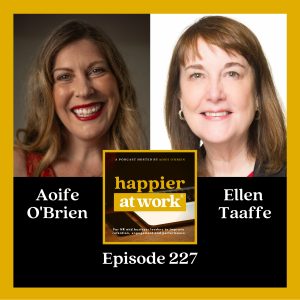
In the latest episode of the Happier at Work podcast, I sat down with the extraordinary Ellen Taaffe to delve deep into the intricacies of women’s leadership and personal growth. Ellen, with her vast experience spanning a 25-year corporate career, board memberships, and her current teaching role at Kellogg School of Management, brings a wealth of knowledge and actionable insights to the table.
Ellen introduces the pivotal mindset shift from “Who am I to do this?” to “Why not me?”. She outlines five strategies to overcome the barriers that hold women back. These include preparing to perfection and eagerly pleasing.
During the episode, Ellen also discusses the challenges posed by perfectionism and the tendency to eagerly please others. She shares insights on how these can lead to being viewed merely as a “worker bee” and holding back from leadership opportunities.
Ellen’s work at the Kellogg School of Management emphasises the need for community and support among women. Ellen’s research and teaching help bridge gaps specific to women in the workplace, addressing challenges like negotiating raises and overcoming biases.
Ellen’s book, “The Mirror Door: Breakthrough the Hidden Barrier That Locks Successful Women in Place,” celebrates its one-year anniversary and has received multiple awards. It explores how self-reflection and internal doubts can prevent women from advancing and emphasises the importance of courage over confidence.
The main points:
- How perfectionism and people pleasing can lead to being viewed merely as a “worker bee” and holding back from leadership opportunities.
- It’s essential to balance preparation with timely action.
- While building strong relationships is vital, it should not come at the expense of your personal needs and boundaries.
- The importance of building networks, seeking feedback, and advocating for oneself as strongly as for others.
Do you have any feedback or thoughts on this discussion? If so, please connect with Aoife via the links below and let her know. Aoife would love to hear from you!
Connect with Ellen
Connect with Happier at Work host Aoife O’Brien:
Previous Episodes:
Episode 184: A Framework for Building Happier Work Cultures with Aoife O’Brien
Take Radical Responsibility of your Career with Carla Miller
Episode 219: How to Encourage Women Leaders to Speak up with Carla Miller
Aoife O’Brien [00:00:02]:
Ellen, you’re so welcome to the Happier at Work podcast. I know I heard you on another brilliant podcast, with Ella, and I was just amazed. So I reached out, and I thought I have to connect with this woman. We talked about coming on the podcast, and now here we are.
Ellen Taaffe [00:00:19]:
Aoife, it’s so glad I’m so glad to be with you, and I love your podcast as well.
Aoife O’Brien [00:00:25]:
Thank you so much. Do you want to tell people a little bit about your career history? What brought you to doing what you’re doing today?
Ellen Taaffe [00:00:34]:
Sure. So my name is Ellen Connolly Tafe, and, I had a 25 year corporate career working for Fortune 500 Companies, and, I started in sales, moved into brand management, and eventually, left that pivoted into a small business where I ran a boutique consulting firm, Consulting backed for big companies. At the same time, I joined my first board. I currently serve on 3 boards, and I became a coach after I left that, that consulting firm. And I, love coaching people. I heard about a leadership initiative where I got my MBA, Kellogg School of Management of Northwestern University. And, I joined Kellogg, in 2016, and I teach a class called personal leadership insights, which is all about becoming, figuring out who you are, who you wanna be, and how are you gonna get there. So it’s really close to my heart.
Ellen Taaffe [00:01:40]:
I and I also run the women’s leadership program for MBA students at Kellogg. I’m a clinical associate professor there. And through that work, as well as trying to get more women on boards, and as the mom of 2 young adult daughters, I really grew my advocacy for helping women navigate the workplace and step into their leadership, and that to writing a book that came out a year ago called the mirror door, breakthrough the hidden barrier that locks successful women in place. So I I’m currently doing a mix of things. So teaching, writing, speaking, and advising, you know, as a board director.
Aoife O’Brien [00:02:24]:
Brilliant. I love that. I mean, there’s so much that I want to unpack from what you’ve just said there, but I love this whole idea of personal leadership. Do you wanna talk to me a little bit more about what that means to you?
Ellen Taaffe [00:02:35]:
Sure. So, I think it’s it’s reflecting internally on who you are, what you’re what you’re really good at. You’re I’m a big fan of StrengthsFinder. You know, what are your strengths and and how can you leverage them? I think there’s a double edged sword to our our strengths too. And how do you how do you know what they are and know when, you know, it’s the check engine light? Like, how do you mitigate what those things are? We do a lot of work on what are you identifying what your values are that that guide you, that, you know, help give meaning and and purpose many times in our lives and in our careers. And and we also we get I ask students to get feedback from 3 people and very different feedback than the performance review. But, who you are? How do I get my own way? What opportunities are ahead? What dangers are ahead? And then the last part of being like a self aware leader is understanding your needs, And, that that’s kind of a new concept a lot of times because no one wants to be needy, but we all do have needs. And when our needs are unmet, that’s when we can feel frustrated or irritated or even angry.
Ellen Taaffe [00:04:00]:
But but understanding, like, what do you need to be at your best? You know, in that’s why I love your podcast too. Like, what do you need to be happier at work? Yeah. What what do you need to thrive? Yeah. Yeah. So those are the pillars of who do you who are you?
Aoife O’Brien [00:04:16]:
Yeah. And it’s so it’s so funny that you say that because so I did a a master’s. Let me think. I finished it around 4 years ago. So I probably, it’s just over 4 years since I would have handed in my dissertation. But, you know, it seems like yesterday. But in that, I did all of this research around what does it mean to fit in, what does it mean to belong at work. And I devised from that my happier at work framework, which which includes those three elements that you talked about, the strengths piece, the values piece, and needs.
Aoife O’Brien [00:04:47]:
Like, those are the three core elements. And definitely needs is not something that we ever talk about. And if I think about myself, I never knew that I had needs that needed to be addressed. And it’s not something that we necessarily talk about in the workplace. And going back to what you said, no one wants to be needy, but you certainly know when you feel frustrated at work, and that means that one of your needs is not being met. So it’s so interesting how that that completely overlaps there. I’m interested as well in this idea of the women’s program that you run and how that differs from something that is more generic, let’s say, a generic leadership program.
Ellen Taaffe [00:05:32]:
I think a lot of the things that we cover in it are relevant regardless of gender. But where we go deeper in is is where there are researched gaps between, that that women face. And so there are ways to try to figure out how do you overcome that. So for example, something like negotiations is is part of the women’s leadership seminar series that I run and teach in. But I I bring in, you know, a a world renowned negotiations expert who’s on our faculty. And, she also teaches a great class for everyone. But one of the things we know is that many times women don’t ask, and now that we’ve started to teach women how to negotiate and they ask more, sometimes they face more backlash. So
Aoife O’Brien [00:06:25]:
Okay. Yeah.
Ellen Taaffe [00:06:26]:
Yeah. The class becomes a different we have different topics of, like, why do we not ask? And then when we ask, how do we handle that sometimes there there might be backlash, based on, you know, from men and women, based on some just kind of underlying, things that are sort of rooted in our past and and rooted in the way the business world has been. So so for it’s really research gaps that we can talk about pretty openly and help our our students be able to form a network of people that can help support them as they go back into the world of of work and are and are navigating things in real time.
Aoife O’Brien [00:07:11]:
Yeah. And I think that’s so important as well just to have that group. So I know, certainly, I’ve taken part in programs, and you stay connected with the people beyond just what the program delivered. So you’re in a WhatsApp group or whatever it might be, but you stay connected. It’s a way to hold each other accountable. It’s a way to share wins that you’ve had at work or it’s a way to to share frustrations or backlash like you’re saying. Like, what can I do in this situation? You know, things like that. So I think it’s it’s so important, but it’s interesting and not something I had really thought about.
Aoife O’Brien [00:07:43]:
So it’s not just about teaching women how to negotiate better or to ask for more because there is a difference between how much women ask and how much men ask. But when they do ask, then it’s more likely that rejection or backlash is going to come. So it’s how to deal with those kinds of issues as well, which maybe highlights some of the you haven’t specifically said it, but biases or you know, and we’ve talked about this on the podcast before where a woman is in quite a senior position, but she fought really hard to get there. And she doesn’t want to make it easy for other women to get there because why should it be easy for them when she had to fight so hard to get there? Or she’s protecting the hive and, you know, she wants to be the only woman at that level, whatever it might be, all of these things kind of going on. What are the sorts of things that you’re seeing?
Ellen Taaffe [00:08:37]:
I I do think that that what you just shared does still go on sometimes. I think it’s it’s getting relegated to the past. Okay. Good. I’m really intrigued with this idea that has, come on a bit stronger through social media or TikTok over here, that is this idea of being a girl’s girl that in my generation, being called a girl was a negative, was like a put down. And today’s younger generation is like being a girl’s girl, someone who stands up for others. It’s not being competitive, and some of the things that, you know, women have gotten pitted against each other in the past. And my view is, like, go get them.
Ellen Taaffe [00:09:22]:
Like, I I love them. And how do we all be girls’ girls? So when when there are these programs like the women’s leadership seminar, it is about creating competencies and, connection, and it’s creating that community too. That, you know, the when we have more seats at the table, there’s less likely to be that negative behavior of the past when someone was sort of guarding that one seat for the woman. So as as change the makeup of leadership and of organizations, there’s it’s not a zero sum game.
Aoife O’Brien [00:09:59]:
Yeah.
Ellen Taaffe [00:09:59]:
Yeah. And and there’s more room for all of us and we can help support each other with that too. So I see that. I also, you know, I think one of the things that that women face a lot of times is getting feedback of you need more executive presence or
Aoife O’Brien [00:10:15]:
looking for more Yeah. Yeah. Yeah.
Ellen Taaffe [00:10:16]:
Robin costs.
Aoife O’Brien [00:10:17]:
Yeah. Yeah.
Ellen Taaffe [00:10:18]:
And so that’s executive presence, and and what does that really mean? That’s that’s one of the the topics in the program. I talk about my book. I, in particular, talk about courage. And I think in a in a world where every women’s conference or, you know, women’s articles, there’s so much on we’re searching for confidence, and I truly believe that that’s the outcome of taking action.
Aoife O’Brien [00:10:45]:
Totally.
Ellen Taaffe [00:10:45]:
And what we really need is courage. Yeah. And we have a lot of that already. So we just need to tap into that to move forward. And and I think we’re more ready than we think.
Aoife O’Brien [00:10:55]:
Yeah.
Ellen Taaffe [00:10:55]:
So often to be able to move into action.
Aoife O’Brien [00:10:58]:
I think that’s I mean, there’s again, there’s so much I want to pick up on there. This idea of the girl’s girl. And if I think back to, yeah, my childhood, it’s you kick like a girl or you fight like a girl or whatever. You know, these connotations meaning that you’re not very good or that, you know, they and they might say to a boy, like, you do that like a girl as if it’s something that’s really bad. I am seeing through advertising and things the loads more women in sports or women being shown or not women necessarily, but girls as well, being shown in such that that sort of positive light. So it’s really encouraging to see that. And I saw from your LinkedIn art your LinkedIn newsletter that you did talk about the Girls Girls. So I would encourage anyone to follow along and follow your newsletter as well for insights like that, which I think are are so they’re so interesting, I think, because I I wasn’t aware of this new way of calling girls girls.
Aoife O’Brien [00:11:58]:
But it’s brilliant. And especially if it’s one of those social media trends that we start to see as well. Yeah.
Ellen Taaffe [00:12:03]:
Yeah. It’s a gift of having, 2 Gen z daughters.
Aoife O’Brien [00:12:07]:
This is it. This is it. The courage piece, I think, is so interesting as well because I speak about the topic of impostor syndrome quite a lot. And in my framework, I talk about that the 3rd step is courageous action. And, again, to reiterate your point, it’s not like, you don’t have to wait till you feel confident to do something. You just need to start doing something, and that’s how you build confidence is by taking action. It’s not by waiting around until you feel so confident that you’re ready to take action. And it’s the same with motivation as well.
Aoife O’Brien [00:12:41]:
You’re not gonna sit around and wait till you feel motivated. You need to commit to doing something and then you commit to taking action and you take the action. And that’s how you build motivation and that’s how you build confidence over time as well. So it’s amazing how there are so many parallels here.
Ellen Taaffe [00:12:59]:
I love it. I love it.
Aoife O’Brien [00:13:00]:
The I want you to come on now to your book. Can you talk to me a little bit more about not so much the process, but, like, why did you why did you write it? Like, what’s what need did you see there that that required?
Ellen Taaffe [00:13:17]:
I I had this experience you know, I was new in the job at Kellogg. And at the very first orientation, a female CEO shared her career journey. And when she opened it up for questions, all the hands that shot up were men in the room. And and it was about the audience was maybe 30, 35% women, and I was struck by that because I know how brilliant and interesting and accomplished these these women, you know, in their late twenties. They already did a lot, but they didn’t raise their hands. And it it made me think of myself at my own orientation, but also at times when, you know, I’d join a new board and I’d be too quiet. I’d play the observer a little too long instead of speaking up. And I, I started to see this in some coaching clients, this kind of hesitating, waiting for a more perfect time, in in so many, and I saw it in the research too, like, in in more recent research as well.
Ellen Taaffe [00:14:21]:
And I I think many people have heard of the research of women not going for jobs unless they have, like, almost 10 of the 10 criteria. I had heard that, but I started to see, wow, it’s really validated in in current. And and that led me to think, this is not I thought it’d be different for the younger generation, and and I was seeing that it wasn’t. And and it led me to believe, like, oh, this is a more gendered thing. And, you know, so part of it was in developing my program, starting to write articles, starting to speak about this. I did a TEDx talk. And in the TEDx talk, oh, there’s a little line in there called the mirror door where I said it’s, you know, when we face opportunity, it’s like we’re we’re blocked by a mirror door reflecting inward in a distorted view, and we can’t get anywhere close to the glass ceiling if we don’t move into action, instead of reflecting inward and and and thinking we’re not ready or we’re not worthy and busying our busying ourself doing all the things that worked before instead of trying something new or trying something, you know, that we don’t know with a 100% certainty. So so it kind of it was all these things coming together that I you know, after doing the TEDx talk, I thought, I I wanna take this into a book.
Ellen Taaffe [00:15:48]:
And through that talk, I met someone who AJ Harper, who runs a book workshop, and just decided to go for it. So I think I’m in a late part of my career where it’s all about how do I make a difference. And, you know, I do that in teaching and as a board director, but I also felt like kind of a I gotta get the word out because we are so much more ready than we realize. And we we are you know, I I do believe we face a lot of biases, a lot of institutional issues that lock us out, but we are also locking ourselves in place.
Aoife O’Brien [00:16:27]:
Yeah. Can we talk about those 2 different elements? So on the one hand, there is the internal that you mentioned. So maybe we’re looking too much in towards ourselves as you mentioned. So we’re facing self doubt. We don’t think that we’re good enough. We don’t think that we’re ready yet. And we’re therefore not putting ourselves forward for opportunities that we’re well ready for. So talk to me a little bit about some of the the challenges associated with that and what you’ve seen from from the research that you’ve done and from from putting the book together.
Ellen Taaffe [00:17:02]:
Yeah. So I I think that this we tend to have a a go to voice that that might be like, who am I to do this? You know, I I had that with who am I to write a book, and I think there’s real power in shifting our mindset to to growth. Like, why not me? I have a message to share. What I what I started to see as I dug into it was, what I what I call these 5 strategies that I think have made us successful but also can unintentionally sideline us, and we don’t always see that. And they’re preparing to perfection, eagerly pleasing, fitting the mold, pushing pedal to the metal, and patiently performing. And each one of them makes us successful. There’s a power to each one. There it tends to be a peril that is both internally, usually in the form of some sort of stress or anxiety, but there’s also apparel somewhat reputationally or how we’re considered by others.
Ellen Taaffe [00:18:10]:
And in each one of them, there there’s things we can do to pivot out of them. Happy to go into them, but but there there are things that it’s kind of a what got us here won’t get us there Yeah. Approach too. So, like, per preparing to perfection, you know, is that person who delivers excellence. They have all the answers, and they do it through a ton of preparation, and they show up perfectly. And, you know, it it feels good that this person becomes the go to. They likely rose first in their class. You know, if they joined an organization where they’re in a cohort, they they did really well.
Ellen Taaffe [00:18:51]:
They’re this is a straight a student, who just knows how to how to deliver. But what happens is as we are in organizations, it just gets more complex. Expectations rise, and we have to move faster. We have to decide with all the less time to prepare. We have to decide with imperfect information. We have to take risks, and those are all a part of leadership what’s expected. And if we hold back in the the I don’t have enough information, we can start to be seen as that worker bee, but not the person to lead the team. And and so this is for me as a as a coach, this is like the person who comes in with, like, I don’t get what happened.
Ellen Taaffe [00:19:39]:
I I have had this stellar career and all of a sudden, it’s like something’s changed or I I plateaued or other people are are ahead of me. And and part of it is learning how to prioritize our efforts, to really discern the risk on big risk things. Maybe it does take all that preparation, but maybe there we are more ready to make a recommendation than we realize, but our past preparation ends up being a crutch many times. And so we gotta realize our readiness, but but ask for help too. You know, and that might look like delegation. That might look like talking to our boss about, you know, what are the a’s, the a effort? What are the b’s? What are the c’s? So, there there’s ways out of this, but it it’s the risk of letting go of of the way we got here, You know, the the heavy preparation and realizing that, you know, to move forward in the leadership, you know, being perfect at it, it’s just never gonna happen.
Aoife O’Brien [00:20:51]:
Yeah. I think Expectations
Ellen Taaffe [00:20:53]:
have changed.
Aoife O’Brien [00:20:55]:
And we’ve talked about perfectionism and we’ve talked about some of the challenges that women face at work on the podcast before, but I don’t think anyone’s ever explained it in the way that you have. And for me, in particular, it’s it really resonates what you’ve said, this idea of having feeling like you have to overprepare. And that can only get you so far because you’re gonna reach a stage where there’s just too much to do that you can’t invest that amount of time. So either you burn out by trying to do everything, you can’t prioritize, you’re not seen as a decision maker, you you are spending too much time analyzing risk, and you’re getting passed over, but you don’t really understand why that’s happening. So I think you you’ve explained it in in such a way that that really resonates with me anyway. I’d love to explore 1 or 2 of the others if you if you want to go into a bit of detail as well on those.
Ellen Taaffe [00:21:49]:
Sure. So, I’ll go to eagerly pleasing, and, this is a great relationship builder, someone who’s really other oriented, and, you know, so many women fall into this because of how we were raised and and perhaps natural instinct too. And it’s it’s a great thing. This is the glue that holds the team together, but it also can mean sometimes we are not in the equation. So we might neglect what matters to us. And and underneath that all, sometimes it can feel like we’re taken for granted and which can lead to feeling angry, or, you know, we can feel like we said something and we ruminate over, oh, did that somehow damage the relationship? And and where this, you know, that so that’s that’s a sort of an anxiety and stress that can come with this. But there’s also within an organization reputationally, you know, we may be seen as too soft and not able to handle conflict. And and here we have to understand that the people who, this might resonate with, our relationships can withstand conflict, but we don’t always trust that and we need to be able to be in the equation balance between others and ourselves.
Ellen Taaffe [00:23:19]:
Women so often can more easily do this when we’re advocating for our team or our family. We advocate for others, but not always for ourselves. And so, you know, we’re if if we stay in this mode, we are not sharing our opinions enough. We’re not raising the issues that need to be raised. And, so often, we need to learn to set boundaries, and we need to we can tap into the care we have of the people we work with, the greater good, the the department, to be able to confront some of these issues. And and sometimes this is just even creating scripts that that are kind of our go to for this. I think just even you know, what I’m concerned about is what I’m wondering about is is a softer way into how’s that gonna work with the timeline? Whatever those things we might feel but not say. So getting ourselves comfortable in the smallest way, like, as you said, courageous actions.
Ellen Taaffe [00:24:25]:
It takes courage when we feel beloved and everyone likes us, but it’s really choosing respect. Because as leaders and as moving up in our organizations, leaders have to confront the issues that we face, and we can disagree without being disagreeable. But but we have this image, this persona of ourselves that that would damage relationships. And do we really want relationships where we can’t raise any issues? Probably not. So it’s it’s sort of a shift of mindset, but then it’s a shift into actions of of in the smallest ways, start to set boundaries, start to raise issues.
Aoife O’Brien [00:25:06]:
Yeah. I think, again, that’s it’s something that we’ve talked about before in the podcast, but maybe not explored it in the same depth that you have there. And I think for me, it resonates really strongly, as well. And, of course, now I’m wondering. I’m like, surely, it’s not a 2020, 2020, 2020 divide. There is probably overlap between some of them or maybe all of them. Certainly from any research I’ve done, the perfectionism piece comes up hugely, hugely. Any thoughts on some sort of a breakdown or the fact that maybe some women experience all 5 of those different challenges?
Ellen Taaffe [00:25:50]:
Oh, I I think you can experience all 5. It’s not a not a a pie to cut off, in this. I would tell you, I probably have been most and eagerly pleasing. I I share a story in the book of of I ended up getting feedback finally that I was considered not tough enough, and I really worked on on that. I I feel like I’m a situational perfectionist. If you saw my closets, you’d say I was not a perfectionist. But but there’s times where I I have, you know, I I think one of the things with perfectionism is, you know, my students say FOMO, but I I believe there’s FOMO, fear of messing up. And I I do have that.
Ellen Taaffe [00:26:38]:
Or Yeah. I too long have I go in quiet into new situations, and I really challenge myself to, like, in this meeting, I’m going to speak up earlier. I’m I’m gonna make 3 comments or things like that because I I wanna have the perfect comment, and it’s just not how it works.
Aoife O’Brien [00:26:57]:
Yeah. Yeah. Yeah. You just have to do it and risk not it not being the perfect comment ever. I I love this that that you’ve shared that you got finally got that feedback. And I want to reiterate that point for anyone who’s listening today because as a recipient of feedback, feedback should be there to help and to support you in your career. And had you got that feedback earlier, you would have been able to take action on that earlier on the assumption that you agreed with what the feedback was saying, and it was delivered in a in an appropriate way and in a way that’s supportive and and is there to help you. And as a leader, it just, again, underlines how important it is to share that feedback and to have those conversations with people because it might be a blind spot.
Aoife O’Brien [00:27:44]:
It might be something that they’re not necessarily aware of. So if it’s something that you perceive in someone else that could be potentially holding them back in their career, absolutely tell them. And if you’re listening to this kind of feedback, take it on board. You know, maybe seek out feedback from other places. I know when I’ve delivered tough feedback in the past, it hasn’t necessarily gone down too well. And, you know, it’s I think it’s it’s hard for the giver and the receiver. But usually, the intentions behind feedback are really positive. So, you know, go and share that feedback and and share it in a really positive way.
Aoife O’Brien [00:28:19]:
But I want to come back to this point as well of the not tough enough and how many people have been told that that maybe you built a career on having really great relationships. And again, you get to a certain level, and having those great relationships and people pleasing and keeping the peace all the time and the harmony in the group is the utmost importance. But actually, how you’re being perceived by other people is that you’re not being tough enough, that you need to you need to bring a bit of conflict into those relationships, or you need to handle them better, or not cover up for people’s mistakes, or whatever it is that you’re doing. So I think it’s it’s such a valuable piece of feedback to receive to be able to like, finally, I’ve got this feedback. Finally, someone was brave enough to tell me that this is the impact that what I’m how I’m behaving is having on the team.
Ellen Taaffe [00:29:11]:
Yeah. I I think that giving, getting, and gaining from feedback is a superpower. I loved your episode with I think it was Nia Thomas, really great episode on feedback. But I I think especially if if clearly pleasing resonates, tapping into our care of the other person in their career to be honest with them and let them know what’s getting in their way. The interesting thing about is she tough enough, women do face a bias of, like, if they are more eagerly pleasing or on that softer side, which is my personality, she get you know, I get the is she tough enough, like other women get too. On the other hand, someone who is does not sort of share their warmth upfront, they get considered, does anyone wanna work for her?
Aoife O’Brien [00:30:07]:
Yeah. Yeah. Yeah.
Ellen Taaffe [00:30:09]:
So there there is this this this warmth competency, balancing act that, that women navigate based on the biases that are just in our societies of, you know, we expect the warmth, the other orientation from women, but we expect that, toughness, that agency, that the other things from being a leader, and we’re, you know, we are navigating trying to be both. So so it sometimes can feel like walking the tightrope.
Aoife O’Brien [00:30:42]:
Yeah. Well, this is it. And I’m starting to see more and more people talk about emotional intelligence and using more of those types of skills in leadership. So I’m hoping that the narrative eventually is gonna change as those leaders move into more senior roles, and they’re using those types of skills and having those types of conversations and showing warmth and competence at the same time and not the kind of typical masculine traits that we associate with leadership typically.
Ellen Taaffe [00:31:15]:
Great point. I mean, I I think the pandemic has really the pandemic and I would say the younger generations are looking for something different. And so I I truly believe we’re moving away from the way to run businesses is command and control
Aoife O’Brien [00:31:33]:
Yeah.
Ellen Taaffe [00:31:33]:
Top down, do as I say to and there’s times for that in a crisis
Aoife O’Brien [00:31:38]:
Yeah.
Ellen Taaffe [00:31:38]:
For him. But I think, you know, I would add to that, much more collaboration and connection and empathy. And as, as we wanna motivate cross generations in our workplaces and just meet the needs of employees and of our of our communities and society, I think we the the leaders of the best leaders of today and the leaders of the future have that that other side of them. I signed my books, take care and take charge, which is my way of saying it’s it’s sort of the traditionally feminine and masculine.
Aoife O’Brien [00:32:16]:
Yeah.
Ellen Taaffe [00:32:16]:
It’s it’s leaders who have both that are are really the leaders that don’t we all wanna work for.
Aoife O’Brien [00:32:22]:
Yeah. Yeah. Yeah. I love that. And I suppose yeah. Like, that’s a really good point. Think about who is the kind of person that you would like to work for as an individual and how do you be more of that kind of a leader, whether you’re taking example from someone you’ve been led by before or doing the opposite of someone that you’ve been led by before as well. Ellen, before we wrap things up, I’d love to touch on a couple of the external factors that you mentioned.
Aoife O’Brien [00:32:49]:
I know we touched on some of them already, but are there any ones that really kinda stand out? Like, we we kind of talked about this idea of bias, not in a huge amount of detail, but is there anything else that you’re seeing out there as an external factor that is creating more hardship for women to succeed at work?
Ellen Taaffe [00:33:09]:
I I think it it depends on, you know, I I’m in Chicago. I’m in the United States, and, I I think we really need to address care in a different way, care for children, elderly. And I think that it still falls on on women, certainly falls on families. Things like paid leave and more flexibility, more predictability for workers that don’t have a set schedule. So how do you figure out childcare? So I I think that that becomes a real issue for growing families, but also for, you know, key times in our careers are also at a time of childbearing age, and then, you know, generations that are sort of sandwiched between raising kids and having elderly parents that are living longer, but that can sometimes be a care burden, a financial burden. And and I relate it to an external issue that impacts women because because caregiving does still fall more on women. And it and many times, you know, between that and then if there’s compensation gaps, which there still are, may not be true of every company, but there still are. You know, people make the they they look at the equation between what all we have to do in our lives as well as, you know, what they’re getting from work.
Ellen Taaffe [00:34:47]:
So creating heavier workplaces, but that are also sort of fair game for people to succeed, to be compensated fairly, and to support that we have real lives too, are not just workers.
Aoife O’Brien [00:35:02]:
Yeah. We’re starting to see, I I suppose, a shift of that in in Ireland and the UK anyway with gender pay gap reporting. Now that’s not to say I think there’s a bit of confusion between equal pay and gender pay gap. And I’m very aware that equal pay is could still be an issue if their job title is slightly different and things like this that they they find ways or it’s not perceived as as prestigious or whatever it might be. There there still can be some issues there. But with the gender pay gap reporting, it really highlights the difference between the the number of women in senior leadership positions versus in the rest of the organization. So companies are I was gonna say they’re encouraged. No.
Aoife O’Brien [00:35:51]:
It’s not just encouraged. It’s a legal requirement now to do that reporting and then to in Ireland at least, to address specifically what you’re going to do about it. Like, what action steps are you gonna take to close the gender pay gap, which I think is is a really positive thing to to kinda come out from that.
Ellen Taaffe [00:36:12]:
Yeah. That’s that sounds great. I mean, we are we are improving, but we have work to do.
Aoife O’Brien [00:36:19]:
Yeah. This is it. This is it. That seems like a really nice place to to wrap things up. I’d love to know, Ellen, what does being happier at work mean to you?
Ellen Taaffe [00:36:32]:
For me, I go back to the needs conversation of playing to strengths for for me, feeling valued, making a difference, working with smart people who wanna do the right thing. I’m also someone who I love feeling being part of something bigger than myself. You know? So maybe that’s about our mission and purpose of, you know, so the chance to help educate leaders, help help create the next generation of leaders, having a hand in that is really meaningful to me Yeah. When I teach leadership class and coach young leaders.
Aoife O’Brien [00:37:18]:
Yeah. That’s amazing.
Ellen Taaffe [00:37:19]:
And That makes me happy.
Aoife O’Brien [00:37:21]:
Yes. And and it’s so funny because, like, I absolutely that’s what makes me happy as well is working with smart people, working on something that is really purposeful and has a lot of meaning. It’s something I miss a lot actually working when I work on my own. But it is. Like, it’s the smart people doing the right thing but with a mission or a meaning behind what it is that you’re doing and the impacts that you’re going to have on the world. So definitely something that that resonates with me. If people who if people want to reach out, if they want to connect with you, what’s the best place they can do that? And don’t forget to mention the book as well as a reminder.
Ellen Taaffe [00:38:02]:
Sure. So I’m pretty active on LinkedIn, and it’s Ellen Taaffe, t a a f f e. And, I also have a website, ellentaaffe.com, and, I’m on the Kellogg website as well. So there are all those places. And my book is The Mirror Door Breakthrough the Hidden Barrier That Locks Successful Women in Place. And you can, I’m just celebrating the 1 year anniversary of the book and have won many awards for it, and I’m just so enjoyed talking on podcasts and, having these kinds of wonderful conversations and and sharing. I’m now, you know, speaking in organizations as well, trying to spread the word.
Aoife O’Brien [00:38:52]:
Brilliant. Love this. Thank you so much for your time today, Ellen. I really, really enjoyed this conversation.
Ellen Taaffe [00:38:58]:
I did too. We have so much in common.